Saturday, May 26, 2012

Lingo: Information Literacy

Since I'm taking a class on information literacy instruction this summer, this is a good time to ask: What is information literacy and why are librarians so keen on teaching it?

Plain Ol' Literacy

Oddly enough, "illiteracy" preceded "literacy" in common usage. The Oxford English Dictionary (March 2012 Online Edition) quotes a 1660 text as the earliest appearance of "illiteracy" and an 1880 text for "literacy." Nor is this a fluke. Literacy didn't catch up with its negative predecessor until the 1940s:

[click to enlarge]

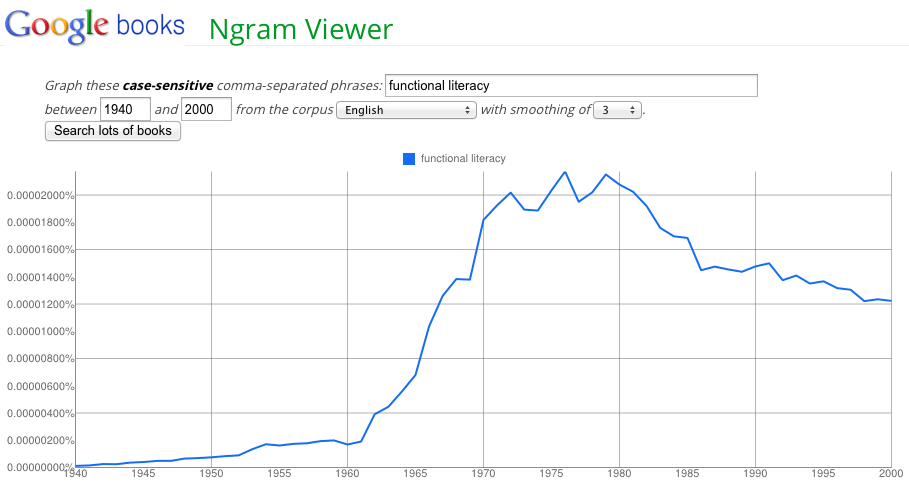
What explains this growing interest in literacy without, apparently, an increase in the discussion of illiteracy? I had trouble finding an answer here. What is clear is that this new, positive focus on literacy developed into a 1960s and 70s interest in functional literacy, which goes beyond basic literacy to include the concept of getting things done in society with written language.

[click to enlarge]

Rise of the Literacies

The next step in the evolution of literacy came in the 1980s with the concept of computer literacy. This was the first decade of household computers. I fondly remember my (parents') Apple IIe with its green screen, big floppy drive, and complete lack of networking. Literacy came to be about competency in some area, without necessarily having a strong connection with written language. A slew of literacy terms came into common use in the 80s and especially the 90s. Information literacy really took off in the early 90s at the same time as the World Wide Web. Probably not a mere coincidence.

[click to enlarge]

Why did computer literacy usage fall while information literacy usage rose? I suspect the novelty of computers as devices was wearing off even as an understanding of networked computers as gateways to information was dawning. At present, iPads represent a high level of technological ease-of-use, but it's still up to human users to wisely locate, evaluate, and use information.

Definitions

There is an ongoing controversy among librarians and other professionals about the precise meaning of information literacy. I take this as evidence that the term "information literacy" is being used to label a bundle of concepts, and not everyone's bundle is quite the same. When it comes to successful communication, the sufficiency of the term will depend on context and the assumptions of those involved. Can you tell I take a very pragmatic view of language? Anyway, let's look at the most prominent short(ish) definition of information literacy:
"To be information literate, a person must be able to recognize when information is needed and have the ability to locate, evaluate, and use effectively the needed information. [...] Ultimately, information literate people are those who have learned how to learn. They know how to learn because they know how knowledge is organized, how to find information, and how to use information in such a way that others can learn from them. They are people prepared for lifelong learning, because they can always find the information needed for any task or decision at hand." — American Library Association's Presidential Committee on Information Literacy: Final Report, 1989
The Association of College and Research Libraries (ACRL) characterizes information literacy as six abilities. "An information literate individual is able to:
  • Determine the extent of information needed
  • Access the needed information effectively and efficiently
  • Evaluate information and its sources critically
  • Incorporate selected information into one’s knowledge base
  • Use information effectively to accomplish a specific purpose
  • Understand the economic, legal, and social issues surrounding the use of information, and access and use information ethically and legally"
from ACRL's Information Literacy Competency Standards for Higher Education, 2000
ACRL fills in a lot of detail for each of these six abilities (or "standards") by breaking each one down into several "performance indicators" and each of those into "outcomes." For example:
Standard: "The information literate student evaluates information and its sources critically and incorporates selected information into his or her knowledge base and value system."
Indicator: "The information literate student articulates and applies initial criteria for evaluating both the information and its sources."
Outcome: "Analyzes the structure and logic of supporting arguments or methods."
Many elements in the above definitions appeared in President Obama's 2009 proclamation of National Information Literacy Awareness Month. I recommend taking a few minutes to read it over.

Why Librarians?

You may be thinking, "Sure, information literacy is important, but it sounds so general. Why is there a special connection to libraries and librarians? Why don't librarians stick with library instruction/bibliographic instruction?" I haven't found a good, critical discussion of these questions (yet), so I'd like to break the "special connection" question into two parts and give my working hypotheses.
Why are librarians so interested in information literacy instruction?
One of the less encouraging responses I've gotten to going back to school to become a librarian is, "There won't be any libraries in a decade." The assumption here is that libraries exist to access books, films, etc. and that libraries won't be needed for much longer due to Internet services like Amazon, Netflix, etc. Libraries are dinosaurs on the verge of following Borders and Hollywood Video to extinction. Maybe public funds would be better spent on direct student or citizen access to digital resources.

At least, this is one specter haunting modern libraries. I see information literacy as a way of establishing continued relevance in the twenty-first century. Access to information may become trivial, but librarians can still function as professional facilitators and teachers of information selection, evaluation, and use. Even the term "Library and Information Science" reflects this shift in philosophy.
Why are librarians relatively more active in the promotion of information literacy compared to other groups?
Basically, librarians are more keyed into these issues as general issues than, say, chemistry or veterinary school teachers. Commercial enterprises and political organizations may be in excellent positions to understand information literacy, but they tend to view people as voters and consumers to manipulate, rather than as individuals to empower. When it comes to spreading the message about information literacy, librarians stand at a particularly relevant intersection of professionalism and philosophy.

Friday, May 18, 2012

The Heterosexual Redefinition of Marriage

Critics of same-sex marriage offer a narrative along these lines:
Marriage has always meant "a union between a man and a woman" therefore it makes no sense to talk about two men or two women marrying each other. Homosexuals are trying to redefine the word "marriage" to mean something completely different from what marriage is!
While it's true that, historically, marriages have nearly always been heterosexual relationships, there is another very plausible explanation: marriage was a kind of male-oriented ownership relation. A man could possess one or more wives, but it it made no sense for men to possess each other or for women to possess each other in this way. It was only with the modern women's movement that marriage has commonly come to mean a co-equal life partnership. Our culture's acceptance of this heterosexual redefinition of marriage from ownership to partnership has already opened the concept of marriage to homosexual partners. Gays and lesbians don't need to redefine marriage. Straights have already done so.

Give Me That Old Time Marriage

Appeals to "traditional marriage" usually invoke the Bible for support, but our marriage tradition has come a long way from Old Testament and even New Testament views on marriage. The Old Testament is especially relevant since religious arguments against homosexuality often rely on the assumption that ancient Jewish laws are still relevant, at least in spirit. Let's start with one of the Ten Commandments:
"You shall not covet your neighbor’s house; you shall not covet your neighbor’s wife or his male servant or his female servant or his ox or his donkey or anything that belongs to your neighbor." Exodus 20:17, NASB
This sure looks like a rule for men about respecting other men's things. At least the neighbor's wife was mentioned before the donkey, even if she does come after the house. Unmarried women were the property of their fathers or their fiancés. If another man were to come along and break her seal (so to speak), it was a crime against the man she belonged to.

 Violation: Consensual sex with a non-engaged virgin.
 Penalty: The man must marry her and pay her father, unless the father decides to keep both the money and his daughter. The woman must comply with her father's decision. (Ex. 22:16-17)

 Violation: Rape of a non-engaged virgin.
 Penalty: The man must marry her and pay her father. He can never divorce her. The woman must marry her rapist. (Deut. 22:28-29)

 Violation: Consensual sex or rape of an engaged virgin in the city.
 Penalty:  Both stoned to death. The man for "violat[ing] his neighbor's wife." The woman for not crying out for help; all city sex is presumed to be consensual. (Deut. 22:23-24, NASB)

 Violation: Consensual sex or rape of an engaged virgin in the country.
 Penalty: The man is stoned to death for harming her fiancé (yes really). No penalty for the woman because she is presumed to have cried out for help, but there was no one in earshot to save her. (Deut. 22:25-27)

 Violation: A supposed virgin lacks a hymen on her wedding night.
 Penalty: She is stoned to death at the doorway of her father's house. (Deut. 22:20-21)

 Violation: A man falsely accuses his new wife of lacking a hymen.
 Penalty: The man must pay a fine to her father, and he can never divorce her. (Deut. 22:13-19)

I realize this notion of forcing women to marry their rapists seems really out of touch with contemporary morality, but I want to be fair and give Hank Hanegraaff a.k.a. Bible Answer Man an opportunity to provide some cultural context:
"First, the Mosaic Law is hardly about letting a rapist off easy. The consequence for raping a woman engaged to be married was stoning (Deuteronomy 22:25). If the woman was not engaged, the rapist was spared for the sake of the woman’s security. Having lost her virginity, she would have been deemed undesirable for marriage—and in the culture of the day, a woman without a father or husband to provide for her would be subject to a life of abject poverty, destitution, and social ostracism. As such, the rapist was compelled to provide for the rape victim for as long as he lived. Thus, far from barbaric, the law was a cultural means of protection and provision." — Hanegraaf in answer to "How could the Bible command a rape victim to marry her rapist?"
A strange answer considering a nation's laws would be an opportune place to provide for the welfare of poor women by other means. At any rate, rape was treated primarily as a harm done to a woman's father or fiancé, which can only be justified under a property view of women.

War Booty

We think of marriage as a mutual choice to commit to each other for life. While there might be some room to hope Israelite fathers consulted their daughters on their choice of husband, foreign women taken after the slaughter of their families couldn't have had any choice but to sexually submit to the men who killed their fathers, mothers, sisters, and brothers.
"When you go out to battle against your enemies, and the Lord your God delivers them into your hands and you take them away captive, and see among the captives a beautiful woman, and have a desire for her and would take her as a wife for yourself, then you shall bring her home to your house, and she shall shave her head and trim her nails. She shall also remove the clothes of her captivity and shall remain in your house, and mourn her father and mother a full month; and after that you may go in to her and be her husband and she shall be your wife. It shall be, if you are not pleased with her, then you shall let her go wherever she wishes; but you shall certainly not sell her for money, you shall not mistreat her, because you have humbled her." — Deut. 21:10-14,  NASB
"Now therefore, kill every male among the little ones, and kill every woman who has known man intimately. But all the girls who have not known man intimately, spare for yourselves. [...]
Now the booty that remained from the spoil which the men of war had plundered was 675,000 sheep, and 72,000 cattle, and 61,000 donkeys, and of human beings, of the women who had not known man intimately, all the persons were 32,000." — Num. 31:17-18, NASB
Forcing an enslaved woman into the marriage bed isn't even permanent. When you tire of her, send her away. Just don't "mistreat" her! Can you imagine the reaction if modern Israel tried this policy of genocide-except-the-virgins? Would we recognize such marriages as marriages?

Big Love

Polygamy, like slavery, was regulated rather than condemned in the Bible. Sometimes these regulations were intertwined:
"If a man sells his daughter as a female slave, she is not to go free as the male slaves do. If she is displeasing in the eyes of her master who designated her for himself, then he shall let her be redeemed. He does not have authority to sell her to a foreign people because of his unfairness to her. If he designates her for his son, he shall deal with her according to the custom of daughters. If he takes to himself another woman, he may not reduce her food, her clothing, or her conjugal rights." Ex. 21:7-10, NASB
Or there's the law about polygamy and inheritance:
"If a man has two wives, the one loved and the other unloved, and both the loved and the unloved have borne him sons, if the firstborn son belongs to the unloved, then it shall be in the day he wills what he has to his sons, he cannot make the son of the loved the firstborn before the son of the unloved, who is the firstborn." Deut. 21:15-16, NASB
Not to mention that prominent holy men like Abraham, Jacob, Gideon, David, and Solomon were never condemned for practicing polygamy as such.

The Lord Your Husband

New Testament views on marriage may seem pretty close to our own, but this might just be a matter of focus. New Testament writers don't discuss marriage arrangements and rules for slavery as much as Old Testament writers did. Polygamy seems to have gone out of style. Slavery is acknowledged but not challenged (Colossians 4:1). The ruler-and-subject concept of marriage was explicitly re-affirmed. Paul wrote:
"Wives, be subject to your own husbands, as to the Lord. For the husband is the head of the wife, as Christ also is the head of the church, He Himself being the Savior of the body. But as the church is subject to Christ, so also the wives ought to be to their husbands in everything. [...]
So husbands ought also to love their own wives as their own bodies. He who loves his own wife loves himself; for no one ever hated his own flesh, but nourishes and cherishes it, just as Christ also does the church, because we are members of His body." Eph. 5:22-24, NASB
Women are told to be submissive; men are told to be loving. There is an order here with God above both men and women equally, yet husbands are still clearly above their wives. Paul reinforced this double hierarchy in 1 Corinthians:
"For if a woman does not cover her head, let her also have her hair cut off; but if it is disgraceful for a woman to have her hair cut off or her head shaved, let her cover her head. For a man ought not to have his head covered, since he is the image and glory of God; but the woman is the glory of man. For man does not originate from woman, but woman from man; for indeed man was not created for the woman’s sake, but woman for the man’s sake. Therefore the woman ought to have a symbol of authority on her head, because of the angels.
However, in the Lord, neither is woman independent of man, nor is man independent of woman. For as the woman originates from the man, so also the man has his birth through the woman; and all things originate from God." 1 Cor. 11:6-12, NASB
To review, marriage in the Old Testament treated women as property purchased from their fathers, or as spoils of war plundered from enemies. Polygamy was occasionally practiced, but polyandry was unheard of. The New Testament urged women to be unilaterally submissive to their husbands. Husbands were to love their wives, not as separate persons, but as part of themselves. The concepts of mutual choice and co-equal partnership in marriage did not yet exist.

Before the Uprising

By the 1760s, around the time of the American Revolution, marriage had evolved in some respects. William Blackstone's Commentaries on the Laws of England carefully distinguished civil marriage from holy matrimony. Both the husband and wife had to consent to the marriage, though boys under 14 and girls under 12 could be "imperfect[ly]" married, then allowed to decide to affirm or void the marriage at those respective ages. Affirmation was implied to involve voluntary sexual union after reaching his or her "years of discretion." Polygamy was expressly forbidden. Forcing slaves into marriage was not addressed, but was likely precluded by the same principle behind the general consent requirement. All of this represents a substantial advance toward modern views on marriage.

Still, once a woman chose to enter into a marriage, she gave up a lot more than her maiden name. Blackstone wrote:
"By marriage, the husband and wife are one person in law: that is, the very being or legal existence of the woman is suspended during the marriage, or at least is incorporated and consolidated into that of the husband: under whose wing, protection, and cover, she performs everything; and is therefore called in our law-french a feme-covert [married woman]; is said to be covert-baron, or under the protection and influence of her husband, her baron, or lord; and her condition during her marriage is called her coverture. [...]
For this reason, a man cannot grant anything to his wife, or enter into covenant with her: for the grant would be to suppose her separate existence; and to covenant with her, would be only to covenant with himself: and therefore it is also generally true, that all compacts made between husband and wife, when single, are voided by the intermarriage. [...]
If the wife be injured in her person or her property, she can bring no action for redress without her husband's concurrence, and in his name, as well as her own: neither can she be sued, without making the husband a defendant. [...]
But, in trials of any sort, they are not allowed to be evidence for, or against, each other: partly because it is impossible their testimony should be indifferent; but principally because of the union of person: and therefore, if they were admitted to be witnesses for each other, they would contradict one maxim of law, "nemo in propria causa testis esse debet" [no one ought to be witness in his own cause]; and if against each other, they would contradict another maxim, "nemo tenetur seipsum accusare" [no one is bound to accuse himself]." — Commentaries on the Laws of England, Book 1, Chapter 15
If any form of marriage deserves to be called "traditional," it's marriage as the lordship of a man over a woman.

The Age of Equality

The Married Women's Property Acts of 1870 and 1882 allowed women in the United Kingdom to own property separately from their husbands. The latter version also recognized women as separate legal entities in many of the ways denied to them under the doctrine of coverage, as discussed by Blackstone above.

One year before the first Married Women's Property Act was passed, John Stuart Mill's essay The Subjection of Women had raised public awareness of the legal inequalities experienced by married women. In practice, husbands had dominion even over their wives' bodies.
"[A] female slave has (in Christian countries) an admitted right, and is considered under a moral obligation, to refuse to her master the last familiarity. Not so the wife: however brutal a tyrant she may unfortunately be chained to — though she may know that he hates her, though it may be his daily pleasure to torture her, and though she may feel it impossible not to loathe him — he can claim from her and enforce the lowest degradation of a human being, that of being made the instrument of an animal function contrary to her inclinations." — John Stuart Mill, The Subjection of Women, Chapter Two
In case the language was unclear, husbands could demand sex whether their wives were willing or not. Husbands could also imprison their wives. At least, they could get away with doing this in England until the watershed "Clitheroe case" (Regina v. Jackson) of 1891. Frustrated with his wife's refusal to live with him, Mr. Jackson and two of his friends seized her as she was coming out of church with her sister, and dragged Mrs. Jackson into a carriage. She was kept in his house, guarded by his friends, while her family "laid siege" to the house and filed for habeas corpus. The first judges refused to intervene, but an appeal judge ruled that a husband may not "imprison" his wife "until she consent[s] to the restitution of conjugal rights." An early women's rights activist wrote in a letter to the editor:
"Of the momentous character of this judgment there can be no question whatever. It is a declaration of law which is epoch-making in its immediate consequences, and its ultimate results reach far into the future, involving indeed the establishment of a higher morality of marriage, and the substitution, in the relation of husband and wife, of the ethics of justice and equality for the old and worn-out code of master and slave." — Elizabeth Wolstenholme Elmy, The Decision in the Clitheroe Case, and Its Consequences
This is precisely the modern "redefinition" of the marriage relationship that this post is about. The idea of partnership marriage has taken time to spread, and is still struggling against the idea of male authoritarian marriage. Stephen Grunlan's recent Christian textbook, Marriage and the Family, has a section explicitly devoted to comparing arguments for "traditional marriage" and "partnership marriage," ultimately leaving it up to the convictions of each couple. It's not a simple matter of religious marriage being one way and secular marriage being the other.

An Open Door

What does all of this have to do with same-sex marriage? I wanted to show that homosexual marriage is — as its opponents claim — incompatible with traditional marriage. But then so are all the heterosexual marriages today which don't feature a man-as-master and a woman-as-servant. A defining characteristic of traditional marriage was a difference in authority based on sex, not merely a difference in sex. This explains why same-sex marriage is an almost entirely new phenomenon, previously blocked by the expectation of inequality. As a contemporary historian puts it:
"The ancient Romans had no problem with homosexuality, and they did not think that heterosexual marriage was sacred. The reason they found male-male marriage repugnant was that no real man would ever agree to play the subordinate role demanded of a Roman wife. Today, by contrast, many heterosexual couples aspire to achieve the loyal, egalitarian relationships that Greek and Roman philosophers believed could exist only in a friendship between two men." — Stephanie Coontz, Marriage, a History: How Love Conquered Marriage, Kindle Edition p. 11.
The long fight against sexism in marriage has opened the door for same-sex marriage. The most respectable form of marriage today is that of a co-equal life partnership, and there's no reason two men, two women, or one of each cannot make this same kind of commitment to each other.

Tuesday, May 8, 2012

The Constitutional Right to Privacy

"It all comes from, I would argue, this right to privacy that doesn't exist in my opinion in the United States Constitution, this right that was created, it was created in Griswold — Griswold was the contraceptive case — and abortion. And now we're just extending it out." — Rick Santorum in an April 7, 2003 interview with Associated Press
Santorum's sentiment here is fairly popular, but is it correct? Well, he's not entirely wrong. The 1965 case Griswold v. Connecticut was the first time an explicit "right to privacy" was given as part of the U.S. Supreme Court's authoritative rationale, but it wasn't pulled out of thin air for the occasion. It had been seriously discussed by legal scholars for at least 75 years prior to Griswold, and had made conscious appearances in Supreme Court cases since the 1910s.

Early Milestones for the Right to Privacy

1886    Boyd v. United States (116 U.S. 616)  [FindLaw] [Wikipedia]
1890    Harvard Law Review IV(5) article "The Right to Privacy" [Google Books] [PDF]
1914    Weeks v. United States (232 U.S. 383) [FindLaw]
1923    Meyer v. State of Nebraska (262 U.S. 390) [FindLaw] [Wikipedia]
1925    Pierce v. Society of Sisters (268 U.S. 510) [FindLaw] [Wikipedia]
1928    Olmstead v. United States (277 U.S. 438) [FindLaw] [Wikipedia]
1958    NAACP v. Alabama (357 U.S. 449) [FindLaw] [Wikipedia]
1960    Poe v. Ullman (367 U.S. 497) [FindLaw] [Wikipedia]
1961    Mapp v. Ohio (367 U.S. 643) [FindLaw] [Wikipedia]
1965    Griswold v. Connecticut (381 U.S. 479) [FindLaw] [Wikipedia]

Boyd v. United States

A critical issue in this case was whether normal fourth amendment protections can be circumvented if, instead of a literal "search and seizure," a citizen is compelled to produce documents. The Court decided that the intent of the law was broader than the acts of searching and seizing themselves.
"It is true that certain aggravating incidents of actual search and seizure, such as forcible entry into a man's house and searching among his papers, are wanting [...]; but it accomplishes the substantial object of those acts in forcing from a party evidence against himself. It is our opinion, therefore, that a compulsory production of a man's private papers to establish a criminal charge against him, or to forfeit his property, is within the scope of the fourth amendment to the constitution, in all cases in which a search and seizure would be, because it is a material ingredient, and effects the sole object and purpose of search and seizure." — Boyd (116 U.S. 616)
At this point we're still talking about private property, though it's hard to maintain that the physical pages are the sole — or even primary — aspect of personal documents intended to be protected by the fourth amendment. What's important about Boyd is the move from the letter of the law to the more abstract purpose of the law.

"The Right to Privacy"

High profile scholarly discussion of a right to privacy began with this Harvard Law Review paper by Samuel Warren and Louis Brandeis. Its opening paragraph is well worth reading:
"That the individual shall have full protection in person and in property is a principle as old as the common law; but it has been found necessary from time to time to define anew the exact nature and extent of such protection. Political, social, and economic changes entail the recognition of new rights, and the common law, in its eternal youth, grows to meet the demands of society. Thus, in very early times, the law gave a remedy only for physical interference with life and property, for trespasses vi et armis ['by force and arms']. Then the 'right to life' served only to protect the subject from battery in its various forms; liberty meant freedom from actual restraint; and the right to property secured to the individual his lands and his cattle. Later, there came a recognition of man's spiritual nature, of his feelings and his intellect. Gradually the scope of these legal rights broadened; and now the right to life has come to mean the right to enjoy life, the right to be let alone; the right to liberty secures the exercise of extensive civil privileges; and the term 'property' has grown to comprise every form of possession — intangible, as well as tangible." (Warren & Brandeis)
What changes were prompting this "broadening" of personal and property protections in the late nineteenth century? "Instantaneous photographs and newspaper enterprise have invaded the sacred precincts of private and domestic life [....]" Paparazzi and tabloids, in today's terms! Warren and Brandeis (W&B) were concerned with the way newspapers — the new gossip "trade" — could publish details of personal lives such as the contents of diaries or letters they manage to get their hands on. Anticipating the objection that copyright law already protected people from having their personal letters published, W&B answered that copyright only protects exact reproduction; all the facts and feelings revealed by a letter could be published by a "gossip-monger."

After distinguishing this right to privacy from copyright, slander, contract law, etc., W&B discuss limitations on privacy. By analogy to slander and libel, they write: "The right to privacy does not prohibit any publication of matter which is of public or general interest." For example, "Peculiarities of manner and person, which in the ordinary individual should be free from comment, may acquire a public importance, if found in a candidate for public office." Yet this doesn't mean public figures give up all privacy rights.

The second limitation on privacy is that normally-impermissible reporting is allowed "when the publication is made under circumstances which would render it a privileged communication according to the law of slander and libel." The third limitation is that "oral publication" i.e. talking about private matters is not grounds for a lawsuit "in the absence of special damage." W&B didn't want to make regular person-to-person gossip illegal. (No doubt they would have phrased things differently if mass communication by radio had existed back then.) Fourth, a person can make his or her own private matters public, after which further discussion is allowed.

This paper's closing line is also worth quoting:
"The common law has always recognized a man's house as his castle, impregnable, often, even to its own officers engaged in the execution of its commands. Shall the courts thus close the front entrance to constituted authority, and open wide the back door to idle or prurient curiosity?" (Warren & Brandeis)
Some things to notice: W&B argued for an expanded understanding of existing protections, not new legislation or judges entirely making up new protections. They wanted the government to discourage private citizens from violating each other's privacy, not just to keep the state out of private affairs. Finally, they were discussing common law, not the Constitution specifically. So why is their paper relevant to a constitutional right to privacy? Because common law theory is a significant part of constitutional interpretation. Subsequent Supreme Court justices will draw on the ideas and language used in this paper, especially in a dissenting opinion for Olmstead v. United States which was written by — surprise, surprise — Brandeis himself after he was appointed to the Supreme Court!

Weeks v. United States

The Court's ruling in Boyd had spoken of "private papers" but not "privacy." Weeks looked back at Boyd and began to use "privacy" language detached from specific possessions:
"[The fourth amendment] took its origin in the determination of the framers of the Amendments to the Federal Constitution to provide for that instrument a Bill of Rights, securing to the American people, among other things, those safeguards which had grown up in England to protect the people from unreasonable searches and seizures, such as were permitted under the general warrants issued under authority of the government, by which there had been invasions of the home and privacy of the citizens, and the seizure of their private papers in support of charges, real or imaginary, make against them." —Weeks (232 U.S. 383), emphasis added.
Nor is this just background information. The Court characterized violations of the fourth amendment as violations of privacy:
"Under such circumstances, without sworn information and particular description, not even an order of court would have justified such procedure; much less was it within the authority of the United States marshal to thus invade the house and privacy of the accused." — Weeks (232 U.S. 383)
Meyer v. State of Nebraska

In 1919, Nebraska passed a law against teaching foreign languages in schools until after the eighth grade, with the intent of closing down German classes. (Immigrant anxiety isn't a new thing.) This was found unconstitutional. How? The Court cited the fourteenth amendment's due process protection of "liberty." If that sounds awfully vague, well, you're right about that. The Court did try to fill in what they took "liberty" to mean:
"While this court has not attempted to define with exactness the liberty thus guaranteed, the term has received much consideration and some of the included things have been definitely stated. Without doubt, it denotes not merely freedom from bodily restraint but also the right of the individual to contract, to engage in any of the common occupations of life, to acquire useful knowledge, to marry, establish a home and bring up children, to worship God according to the dictates of his own conscience, and generally to enjoy those privileges long recognized at common law as essential to the orderly pursuit of happiness by free men." — Meyer (262 U.S. 390)
This should sound familiar! Warren and Brandeis' paper also contrasted an early understanding that "liberty meant freedom from actual restraint" with a maturing right to liberty that "secures the exercise of extensive civil privileges." Whereas that paper had spoken of "a recognition of man's spiritual nature, of his feelings and his intellect," the opinion in Meyer mentions conscience, marriage, family, and the acquisition of useful knowledge. Finally, W&B's paper's "right to enjoy life" can be seen in the Court's phrasing "privileges [...] essential to the orderly pursuit of happiness." This isn't quoting, and it might not even be a direct reference, but it's at least clear that both texts are referring to a related set of ideas about the growth of common law liberties.

Though the word "privacy" doesn't appear in the Court's decision, Meyer v. State of Nebraska would have been a much more appropriate case for Santorum to cite as the beginning of the Supreme Court's recognition of an expansive right to privacy. And it wasn't about contraception or abortion; it was about the parental right to guide the education of their children, as the Court concluded:
"Plaintiff in error taught this language in school as part of his occupation. His right thus to teach and the right of parents to engage him so to instruct their children, we think, are within the liberty of the amendment" — Meyer (262 U.S. 390)
Pierce v. Society of Sisters

In 1922, Oregon passed its own state law to restrict educational options through the eighth grade. Specifically, children had to attend public rather than private schools. Why didn't Oregon realize this would be struck down on account of Meyer? Because the decision in Meyer didn't actually happen until 1923.

Anyway, schoolteacher nuns sued and eventually won on grounds we've seen before:
"Under the doctrine of Meyer v. Nebraska [...] we think it entirely plain that the Act of 1922 unreasonably interferes with the liberty of parents and guardians to direct the upbringing and education of children [...] under their control. As often heretofore pointed out, rights guaranteed by the Constitution may not be abridged by legislation which has no reasonable relation to some purpose within the competency of the state. The fundamental theory of liberty upon which all governments in this Union repose excludes any general power of the state to standardize its children by forcing them to accept instruction from public teachers only. The child is not the mere creature of the state; those who nurture him and direct his destiny have the right, coupled with the high duty, to recognize and prepare him for additional obligations." — Pierce (268 U.S. 510)
The right to privacy being developed in these cases is purely a restriction on state regulation, not Warren and Brandeis' hope for the ability of private citizens to sue each other for breaches of privacy. Their paper has turned out to be very influential in terms of defining privacy, but not so influential in terms of implementation. Instead, the Court has treated privacy rights as a strong presumption against state interference in a variety of areas.

Olmstead v. United States

This was the case that concluded warrantless wiretapping is perfectly fine, so long as the feds tap from the street outside (it was later overturned). What's most important about Olmstead today is Justice Brandeis' dissent. Remember, this is the same Louis Brandeis who co-wrote "The Right to Privacy" 38 years earlier! He built on the Court's earlier reasoning in Boyd that limiting the fourth amendment to physical search and seizure would make it less and less relevant as time goes on:
"The progress of science in furnishing the government with means of espionage is not likely to stop with wire tapping. Ways may some day be developed by which the government, without removing papers from secret drawers, can reproduce them in court, and by which it will be enabled to expose to a jury the most intimate occurrences of the home. Advances in the psychic and related sciences may bring means of exploring unexpressed beliefs, thoughts and emotions." — Olmstead (277 U.S. 438), Brandeis' dissent
And reprising his own paper's theme, he wrote:
"The makers of our Constitution undertook to secure conditions favorable to the pursuit of happiness. They recognized the significance of man's spiritual nature, of his feelings and of his intellect. They knew that only a part of the pain, pleasure and satisfactions of life are to be found in material things. They sought to protect Americans in their beliefs, their thoughts, their emotions and their sensations. They conferred, as against the government, the right to be let alone-the most comprehensive of rights and the right most valued by civilized men. To protect, that right, every unjustifiable intrusion by the government upon the privacy of the individual, whatever the means employed, must be deemed a violation of the Fourth Amendment."— Olmstead (277 U.S. 438), Brandeis' dissent
Thus Brandeis anchors his earlier "right to privacy" ideas in the fourth amendment, as the fundamental reason for the amendment.

NAACP v. Alabama

In the mid 1950's Alabama tried to keep the National Association for the Advancement of Colored People (NAACP) from legally operating in the state. As part of this process, a court ordered the NAACP to produce membership lists. Although the NAACP cooperated in other aspects, it said "no" to revealing its standard (non-officer) members. The Supreme Court ruled in favor of the NAACP.
"It is beyond debate that freedom to engage in association for the advancement of beliefs and ideas is an inseparable aspect of the 'liberty' assured by the Due Process Clause of the Fourteenth Amendment, which embraces freedom of speech. [...]

It is hardly a novel perception that compelled disclosure of affiliation with groups engaged in advocacy may constitute as effective a restraint on freedom of association as the forms of governmental action in the cases above were thought likely to produce upon the particular constitutional rights there involved. This Court has recognized the vital relationship between freedom to associate and privacy in one's associations." — NAACP (357 U.S. 449)
The idea here is that what's required for a right (association) may become recognized as a right itself (privacy).

Poe v. Ullman

Finally, a contraception case! Think of Poe as a trial run of Griswold, since both cases were about the same Connecticut law. A married couple had gone through three consecutive pregnancies, resulting in children with "multiple congenital abnormalities from which each died shortly after birth." Their doctor suspected a genetic problem, believing further pregnancies would likely turn out the same. Another woman was seriously injured by a pregnancy and was warned that another pregnancy would threaten her life. Both married women wished to learn how best to prevent conception, but a state law made it illegal for doctors to advise patients on contraceptive use and for citizens to make use of contraceptives. The Court decided not to address questions of constitutionality and dismissed the case because the couple had not actually been charged for violating the law.

However, Justice Douglas dissented saying:
"If there is a case where the need for this remedy in the shadow of a criminal prosecution is shown, it is this one [....]

What are these people - doctor and patients - to do? Flout the law and go to prison? Violate the law surreptitiously and hope they will not get caught? By today's decision we leave them no other alternatives. It is not the choice they need have under the regime of the declaratory judgment and our constitutional system. It is not the choice worthy of a civilized society. A sick wife, a concerned husband, a conscientious doctor seek a dignified, discrete, orderly answer to the critical problem confronting them. We should not turn them away and make them flout the law and get arrested to have their constitutional rights determined." — Poe (367 U.S. 497)
Douglas argued that the first amendment's freedom of speech clause applied to doctors giving advice on contraception. He also argued that forbidding the use of contraceptives "deprives them of 'liberty' without due process of law, as that concept is used in the Fourteenth Amendment." He cited the part of Meyer v. State of Nebraska that affirmed a right "to marry, establish a home and bring up children" (as quoted above). If the state cannot interfere with a married couple's choice to have children, how can it interfere with their choice not to have children?

In his conclusion, Douglas wrote, "This notion of privacy is not drawn from the blue. It emanates from the totality of the constitutional scheme under which we live" (Poe). He contrasts our "constitutional scheme" with the way totalitarian societies claim every aspect of life is within the state's business.

Mapp v. Ohio

Mapp is significant for overruling an earlier case, Wolf v. Colorado (338 U.S. 25), where it had originally been decided that the fourth amendment applied to state governments, but that any materials obtained through illegal search and seizure could still be used as evidence in state courts. So while the Wolf court recognized a "right of privacy," it was understood as a restriction only on the federal government, not a right of all citizens against their state governments as well.

In Mapp, the Court extended the "right to privacy" to states, making it (or recognizing it) as a right of the people in the sense we now find most familiar.
"Today we once again examine Wolf's constitutional documentation of the right to privacy free from unreasonable state intrusion, and, after its dozen years on our books, are led by it to close the only [...] courtroom door remaining open to evidence secured by official lawlessness in flagrant abuse of that basic right, reserved to all persons as a specific guarantee against that very same unlawful conduct. We hold that all evidence obtained by searches and seizures in violation of the Constitution is, by that same authority, inadmissible in a state court." — Mapp (367 U.S. 643)
There are several other explicit affirmations of a constitutional right to privacy in Mapp. Why, then, isn't Mapp cited in place of Griswold as a privacy case of highest importance? Because this rationale behind the judgment was only supported by a plurality — not a majority — of justices.

Griswold v. Connecticut

Finally, a case that simultaneously...
  1. Invokes a right to privacy
  2. Against all levels of government
  3. Uses the phrase "right to privacy"
  4. In the majority opinion
  5. In a majority rationale
Griswold concerned the same state law as Poe (discussed above). Since the Court had refused to consider the constitutional merits of an unenforced law, Planned Parenthood League of Connecticut made a show of violating the law in order to provoke the state into creating a test case. Two $100 fines and some lower court rulings later, the Supreme Court took up the issue for real this time.

What makes any claim about the right to privacy starting in Griswold truly astonishing is that the Griswold opinion cites all of the above cases except Weeks v. United States. There's also a useful summary of how the right to privacy is a kind of background condition for a number of rights enumerated by the Constitution:
"The foregoing cases suggest that specific guarantees in the Bill of Rights have penumbras, formed by emanations from those guarantees that help give them life and substance. [...] Various guarantees create zones of privacy. The right of association contained in the penumbra of the First Amendment is one, as we have seen. The Third Amendment in its prohibition against the quartering of soldiers 'in any house' in time of peace without the consent of the owner is another facet of that privacy. The Fourth Amendment explicitly affirms the 'right of the people to be secure in their persons, houses, papers, and effects, against unreasonable searches and seizures.' The Fifth Amendment in its Self-Incrimination Clause enables the citizen to create a zone of privacy which government may not force him to surrender to his detriment. The Ninth Amendment provides: 'The enumeration in the Constitution, of certain rights, shall not be construed to deny or disparage others retained by the people.'" — Griswold (381 U.S. 479), bolding added
It should be overwhelmingly obvious at this point that the right to privacy was not made up for the sake of "the contraceptive case." It's about restricting government intrusion into our personal lives in a wide variety of areas, including the right to send one's children to a private school, to join a club or attend a church without being put on a membership list for government use, and to not be convicted of a crime based on illegally obtained evidence.

And, yes, the right to privacy also means the police can't bust you for using a condom.

Wednesday, April 25, 2012

Lingo: Formal Equality and Substantive Equality

A recurring theme in the excellent lecture series "Civil Liberties and the Bill of Rights" by John Finn is the contrast between formal equality and substantive equality. This distinction may apply to discussions about equality of opportunity, equal protection of the law, or just about any other time when a more precise definition of equality is required. In brief:

formal equality — the rules, criteria, process, etc. do not explicitly discriminate

substantive equality — the effect of the rules, criteria, process, etc. is non-discriminatory

Most sports involve formal equality. In a professional baseball game, we want the rules to apply to both teams in the same way, even if this means one team is much more likely to win than the other. But in amateur golf, handicap may be used to give players of different skill levels a roughly similar likelihood of winning; this is a form of substantive equality.

Early women's rights supporter John Stuart Mill argued in favor of formal equality:
"It is not sufficient to maintain that women on the average are less gifted than men on the average, with certain of the higher mental faculties, or that a smaller number of women than of men are fit for occupations and functions of the highest intellectual character. It is necessary to maintain that no women at all are fit for them, and that the most eminent women are inferior in mental faculties to the most mediocre of the men on whom those functions at present devolve. For if the performance of the function is decided either by competition, or by any mode of choice which secures regard to the public interest, there needs be no apprehension that any important employments will fall into the hands of women inferior to average men, or to the average of their male competitors. The only result would be that there would be fewer women than men in such employments [....]" — from The Subjection of Women
In Mill's day, the laws did explicitly discriminate against women. So the least a reasonable society could do, he argued, was to take away these formal barriers and let the skill and strength of individual women be measured against male competitors. Today, formal discrimination against women is (usually) unthinkable in western democratic societies. Yet formally non-discriminatory policies can have discriminatory effects against women. One motivation behind the Family and Medical Leave Act was to help with the situation where women have to choose — in a way men do not — between having children and continuing their careers.

Perhaps the most famous snarky remark about formal equality came from Anatole France:
"The law, in its majestic equality, forbids the rich as well as the poor to sleep under bridges, to beg in the streets, and to steal bread."
(A good quote to recite the next time someone points out that both heterosexuals and homosexuals are forbidden to marry persons of the same sex.)

Another area where the distinction between formal and substantive equality comes up is voter ID legislation. A formally fair process (ID required to vote) can have discriminatory effects (fewer poor or even fewer blacks voting). It's not enough to cite formal equality and brush off the complaint. If there is an imbalance in effect, we need ask if formal equality is all we really care about — as with professional baseball teams — or whether we're concerned enough with the substantive inequality to do something about it.

Tuesday, April 24, 2012

Conference Notes Day 2

[Day 1 notes here.]

Saturday's notes...

9:30

Peter Railton led off with the questions: Why did Kant write a third Critique? He had already written about pure reason and practical reason, wouldn't that cover everything? Why address judgment separately?

Answer: in order to be responsive to reasons we need some capacity that doesn't reduce to reason and isn't required by reason. The discussion of aesthetics in the Critique of Judgment is meant as an area which highlights the psychological sensibilities that drive what we do with our reasoning.

Railton went on to characterize even ordinary belief as a combination of representation and attitude. (I suppose this is what's meant by "propositional attitude" but I hadn't thought so explicitly about it before.) Adjustments to the strength of our beliefs are then characterized as adjustments to our attitude toward some proposition. Railton put up a diagram of a Bayes-like "tuning circuit" to illustrate this point. When things are working properly, our belief-attitudes should adjust each time we're faced with a confirmation or a discrepancy. I thought about entrenched political and religious divides as being cases where this "circuit" has gone into a runaway cycle of attitude reinforcement, even for what we usually think of as purely descriptive beliefs.

I really liked Railton's presentation of intrinsic value. Using the aesthetics metaphor, we don't need to believe in an ontologically mysterious value in artistic works to make sense of most "intrinsic value" talk. Instead, we can understand it as taking a broader perspective. I can't remember his example, so I'll use troll dolls. Let's say I love troll dolls. As far as I'm concerned, these things are tops when it comes to aesthetic value. But if we take a wider survey of tastes around the world and through time, troll dolls aren't going to make any Top Ten lists. Broad human sensibility isn't strongly attuned to troll dolls, even if my personal sensibility is. Meanwhile, van Gogh paintings do very very well on the broadness test.

If I could sign up for lectures with any of this conference's presenters, Railton would be my immediate choice. He's so casually thoughtful and interacts well in dialogue.

11:15 

Mark Schroeder presented his paper "Tempered Expressivism" which is more specifically about relational expressivism. I particularly like his concise definition of expressivism in this paper:
"The basic idea of expressivism is that for some sentences ‘P’, believing that P is not just a matter of having an ordinary descriptive belief. This is a way of capturing the idea that the meaning of some sentences either exceeds their factual/descriptive content or doesn’t consist in any particular factual/descriptive content at all, even in context."
Schroeder then introduces three labels for expressivist theories. Unrestrained expressivist theories allow any state of mind to be expressed by P. Restrained theories place some kind of limit, e.g. it might have to be a state of mind with which it's possible to disagree. Tempered theories have a special kind of restraint: the state of mind must be "belief involving"; there has to be a descriptive belief in there somewhere. This restriction on tempered expressivist theories helps them deal with traditional challenges to expressivism, such as how to make sense of compositions like, "If lying is wrong, then getting your little brother to lie is wrong." (See "What is the Frege-Geach Problem?").

Next, Schroeder highlights two ways descriptive beliefs can be "involved" which, in turn, leads to two forms tempered expressivism might take: hybrid expressivism and relational expressivism. The primary example Schroeder gives of hybrid expressivism is essentially Daniel Boisvert's Expressive-Assertivism, which I've written about before. There are other forms of hybrid expressivism in the literature. Relational expressivism, by contrast, hasn't really been explored. What's the difference?
hybrid expressivism — "moral sentences express states of mind that consist in both an ordinary descriptive belief and a desire-like attitude"

relational expressivism — "moral beliefs consist in a certain relation holding between one’s ordinary descriptive belief state and some kind of desire-like attitudinal state"
I'm still having a hard time fully grasping the distinction Schroeder is making here. At first, I took relational expressivism to be a more restricted form of hybrid expressivism, but this was wrong. Schroeder writes, "The key insight we’ll need is that hybrid expressivism is really just a special case of relational expressivism." From what I now understand, hybrid expressivist theories are more specific about which belief and which attitude a person must hold in order to accept a given moral sentence. Meanwhile, relational expressivist theories can get away with being less substantive about the identity of beliefs and attitudes in moral statements so long as a certain class of relationship holds between them.

Schroeder does give a rough example of relational expressivism, but then he says it's not a good example (because adding detail to the belief component shouldn't be able to flip the judgment in proper relational expressivist theories) and instead directs readers to Teemu Toppinen's paper "Belief in Expressivism" which will appear along with Schroeder's paper in Oxford Studies in Metaethics vol. 8.

2:15

Steve Finlay and Justin Snedegar presented their paper "One Ought Too Many" which defends the claim that the word 'ought' itself has a more-or-less uniform meaning, as opposed to having significantly different meanings in different kinds of sentences.

For example, suppose there's a party with the door prize of kissing Mary. Bill is holding the lucky ticket.

(1) It ought to be the case that Bill kisses Mary.
  vs.
(2) Bill ought to kiss Mary.

Finlay and Snedegar (F&S) don't insist these two sentences have identical meaning as a whole (we communicate something different when we choose one form over the other). Rather, they argue that this difference can be explained without resorting to 'ought' itself meaning one thing in the first sentence and something else in the second sentence.

What's the difference between (1) and (2)? Well, sentences like (1) are more like an impersonal evaluation of the situation while sentences like (2) are much more directly concerned with an agent's deliberative choice of what to do. These are called evaluative readings vs. deliberative readings respectively. So why do "It ought to be..." forms (tend to) generate evaluative readings and "[Agent] ought to..." forms (tend to) generate deliberative readings? If 'ought' always has the same meaning, shouldn't both readings be equally available for both sentence forms?

F&S suggest that the social and linguistic context of 'ought' can imply different contrast classes for 'ought' to operate on. Certain kinds of contrast classes result in deliberative readings. So sentences like (1) tend to generate contrast classes which yield evaluative readings. Sentences like (2) tend to generate contrast classes which yield deliberative readings. For example:

It ought to be the case that [Bill | Tom | Lucy] kisses Mary.
  vs.
Bill ought to [kiss Mary | ignore Mary | kiss Lucy].

If context suggests these as the alternatives on the table, notice how the second sentence — unlike the first — yields a set of options for a particular agent to deliberate about and choose.

It might seem like F&S are just trading one kind of complexity (multiple semantics) for another kind of complexity (adding the contrast class step), but not if the contrast class step is used in 'ought' semantics anyway, which it arguably is.

4:15

Finally, Connie Rosati gave a talk on what it means for one's life to have meaning. She spent of a lot of time criticizing Susan Wolf's views on the matter, which caused some audience consternation in the Q&A. Rosati's own views are a bit nebulous. She focused on the idea of communicating something through one's life, but didn't want to require that anyone actually receive this communication, nor did she want to allow just any sort of powerfully communicating life to count (someone had dragged out Hitler).

Provocatively, she said her own life isn't meaningful and that other accounts of meaning apply the label far too liberally to average lives. When asked whether this means average lives are meaningless, she also said 'no.' I was baffled. The closest analogy I can draw to this pattern of thinking is the way many religious people reserve "holy" for a few highly revered people or activities, but don't characterize mundane things as "unholy."

Wrap-up

I missed the party Saturday night due to sudden illness and also missed Michael Smith's talk on Sunday morning because I had library class in Omaha (semester complete, yay!). Happily, his talk was loosely based on a paper available online: "The Rational Foundations of Morality."

Overall, I really appreciated the opportunity to hear from writers I already knew a little about (Dreier, Railton, Schroeder, Finlay, and Smith) and become acquainted with some new folks. From a sociological angle, I enjoyed observing the mix of personalities, clothing styles, gender and age demographics, and ratio of bearded vs. unbearded men.

I'll leave you with a quick practical reasoning anecdote from Jamie Dreier's talk. When he bought his coffee on Friday morning, the Starbucks employee insisted on putting the cup on the counter rather than hand it directly to him. He asked why. It's policy, she explained, Starbucks doesn't want to risk liability from burning customers on a bad direct handoff. Jamie held up his coffee and shook it for the audience. It was iced coffee.

Friday, April 20, 2012

Conference Notes Day 1

Today I attended the Practical Reason and Metaethics Conference in Lincoln, Nebraska. I learned that I can identify people surprisingly well after seeing just one photo from a faculty website or book jacket months ago. I also learned that if you want an easy Q&A segment after presenting a paper, avoid having Michael Smith in the audience (who, incidentally, is quite the iPad sketch artist).

9:30

Events kicked off with a presentation by Jamie Dreier titled "Quasi-Realism and the Problem of Unexplained Coincidence." The Problem of Unexplained Coincidence (PUC) is about explaining why we have reliable moral beliefs. For some kinds of anti-realists, this presents no problem because our moral beliefs only need to track our own attitudes, or or own conventions, etc. Moral realists supposedly have the most trouble because there's no obvious — or at least no non-controversial — story about how our beliefs track moral properties that aren't so closely tied up with human psychology or human society.

Dreier's talk, however, was focused on how quasi-realists might handle this problem. He did so by presenting an interesting thought experiment. Imagine a society that speaks a special form of English: one that lacks any evaluative terms. They still have feelings and attitudes similar to our own, but they have to describe (or report) their feelings rather than express them in any other linguistic ways. Presumably, these people wouldn't be faced with the PUC. Dreier went on to advance their linguistic toolkit step-by-step in a quasi-realist fashion until their communicative practices looked pretty much like our own. Since the PUC didn't seem to appear at any of these steps, and it wasn't present on the first step, it would follow that the final stage  — which looks like us — would remain free and clear of the PUC. So actual quasi-realists can, arguably, dodge the PUC.

This thought experiment can be attacked at a number of stages, which Dreier admitted and the audience took as an invitation to do so. And even if the argument itself were totally convincing, Dreier worried we would still be short a satisfying explanation of why the argument works. I would love to read a fleshed-out story of the thought experiment itself. Think The Invention of Lying except with the invention of moral predicates!

11:15

Jonathan Way presented his paper "Reasons as Premises of Good Reasoning." His talk took the form of explaining a promising understanding of what constitutes a reason for action, pointing out a difficulty, then taking his own shot at overcoming that difficulty. I'm not sure I understood him correctly, but I'll give an example anyway.

A promising understanding:

Suppose it's raining. For this fact to count as a reason for me to take an umbrella with me, it must be good reasoning to combine some set of my psychological states with the belief that it's raining and therefore take an umbrella with me.

A difficulty:

Suppose the only available umbrella belongs to the queen and she'll have my head if I take it. I have stronger reason to leave the umbrella alone. So it would seem like my psych states plus a belief that it's raining would not be good reasoning which concludes with me taking the umbrella. But it would be weird to conclude that the fact of rain is not a reason at all for me to take an umbrella.

A proposed solution:

For the fact that's raining to count as a reason for me to take an umbrella with me, it only has to be defeasibly good reasoning to combine some set of my psychological states with the belief that it's raining and therefore take an umbrella with me. It's a kind of reasoning that can lead to bad results (like taking the queen's umbrella).

2:15

Next up, Nomy Arpaly gave a talk that didn't have a title so far as I noticed. The main idea seemed to be that "bad reasoning" can be a matter of something going wrong with beliefs, not necessarily the reasoning itself. Her primary example involved two instrumental beliefs and how they combine with the same desire:

Instrumental belief #1: Putting coins in this Coke machine will produce a Coke.
Instrumental belief #2: Putting coins in this pencil sharpener will produce a Coke.

Desire: a Coke.

A person holding the first belief along with the desire might reason her way to putting a coin in a Coke machine. A person holding the second belief along with the desire might reason her way to putting a coin in a pencil sharpener. Is the first case good reasoning and the second case bad reasoning? Maybe not! Instead, there may just be some problem with the story behind instrumental belief #2 that's messing things up; putting coins in pencil sharpeners doesn't have the right kind of relationship with Coke production.The precise nature of what relationship is needed was, ah, vigorously discussed during the Q&A.

4:15

Finally, Michael Bratman took a read-the-paper-aloud approach to "Why be Means-End Coherent?" As much as I struggled with Way and Arpaly's talks on practical reason, I had a much worse time getting into Bratman's paper. His topic may have simply been too abstract for me to grasp. And it might have helped if I had stayed through the Q&A, but I had to duck out early to see my chiropractor. 

Tomorrow's lineup is: Peter Railton, Mark Schroeder, Stephen Finlay/Justin Snedegar, and Connie Rosati.

Thursday, April 12, 2012

Public Forum Doctrine in U.S. v. American Library Association

United States v. American Library Association was a 2003 Supreme Court case that examined the constitutionality of CIPA, the Children's Internet Protection Act.
"[CIPA] is a federal law enacted by Congress to address concerns about access to offensive content over the Internet on school and library computers. CIPA imposes certain types of requirements on any school or library that receives funding for Internet access or internal connections from the E-rate program – a program that makes certain communications technology more affordable for eligible schools and libraries." — http://www.fcc.gov/guides/childrens-internet-protection-act
Basically: filter your Internet or miss out on federal funding.

The American Library Association led a lawsuit against CIPA on the grounds that filtering intended to block unprotected speech also inevitably blocks constitutionally protected speech, which violates the First Amendment rights of public library patrons. This legal argument had two critical points.
  1. Internet access in public libraries constitutes a public forum. Therefore content regulations are subject to strict scrutiny.
  2. CIPA fails under strict scrutiny because filtering is not narrowly tailored to the government's compelling interest in blocking unprotected speech ("obscenity, child pornography, or material harmful to minors"). 
Despite an earlier U.S. District Court ruling that CIPA was unconstitutional for these reasons, the Supreme Court ruled 6 to 3 in favor of CIPA. Unfortunately the breakdown of opinions was rather complicated:

Opinion of the Court (plurality) — Rehnquist, O'Connor, Scalia, and Thomas
Concurrence — Kennedy
Concurrence — Breyer
Dissent — Stevens
Dissent — Souter, Ginsberg

Since the Opinion of the Court represented a mere plurality rather than a majority, only its judgment — not its rationale on the whole — is authoritative. On the other hand, a plurality of four justices only needs one concurring justice to agree with part of its rationale for that part to count as a majority (authoritative) rationale. One such rationale for finding CIPA constitutional was simply this: Internet access in public libraries does not constitute a public forum.
"Internet access in public libraries is neither a 'traditional' nor a 'designated' public forum." — Opinion of the Court

"The public forum principles on which the District Court relied [...] are out of place in the context of this case. In determining whether the statute's conditions consequently violate the First Amendment, the plurality first finds the "public forum" doctrine inapplicable [...], and then holds that the statutory provisions are constitutional. I agree with both determinations." — Breyer's concurrence
Nothing more really needed to be said before reversing the District Court's ruling. Without classification as a public forum, Internet filtering isn't subject to strict scrutiny and so it doesn't need to be "narrowly tailored." For the sake of argument, however, the plurality went on to comment:
"Assuming that such erroneous blocking presents constitutional difficulties, any such concerns are dispelled by the ease with which patrons may have the filtering software disabled." — Opinion of the Court
This was important guidance for libraries or legislatures interested in avoiding any chance of "constitutional difficulties." Everyone could rest assured that strict scrutiny was off the table, but U.S. v. ALA did not settle the question of which lower standard of judicial review might apply. Breyer and the plurality did not agree on this point:
"Just as forum analysis and heightened judicial scrutiny are incompatible with the role of public television stations and the role of the NEA, they are also incompatible with the discretion that public libraries must have to fulfill their traditional missions. Public library staffs necessarily consider content in making collection decisions and enjoy broad discretion in making them." — Opinion of the Court

"Instead, I would examine the constitutionality of the Act's restrictions here as the Court has examined speech-related restrictions in other contexts where circumstances call for heightened, but not 'strict,' scrutiny--where, for example, complex, competing constitutional interests are potentially at issue or speech-related harm is potentially justified by unusually strong governmental interests. Typically the key question in such instances is one of proper fit." — Breyer's concurrence
So it's unclear whether the selection decisions of library staff are subject to heightened scrutiny or merely rational review. This uncertainty is compounded by the uncertainty of what would happen in any particular instance of applying heightened scrutiny; it's a vague standard.

The Other Four Justices

How did Kennedy's concurrence play into all this? He ignored the question of public forum doctrine and jumped straight into the plurality's hypothetical situation wherein strict scrutiny is applied and CIPA passes anyway because adults can request to have the filter disabled.

Both dissents treated Internet access in public libraries as a public forum then went on to characterize filtering as overly broad — rather than narrowly tailored — for the purpose of shielding children from unprotected speech.

Conflicting Interpretations Today

In the current edition of the American Library Association's Intellectual Freedom Manual, Theresa Chmara writes:
"In sum, public libraries must remain cautious about using filtering. Ultimately, the CIPA scheme was upheld because it was tied to funding and the government conceded that an adult’s request for disabling of the filter could never be denied and did not have to be justified. The Supreme Court also left no doubt that in a case challenging the application of filtering software, a library would be liable if it did not disable a filter to provide access to constitutionally protected material." (OIF, p. 345)
Despite this, a library system in rural Washington State has chosen to filter all computers without the option to entirely disable filtering on request, even when constitutionally protected material stays blocked as a result. Just this week, a U.S. District Court ruled in favor of the library system's choice of filtering policy. The District Court cites U.S. v. ALA to say that strict scrutiny is inappropriate; it also cites a Ninth Circuit decision in support of rational review when government services are allowed to make content choices. Notice how the plurality's support of rational review in the Supreme Court case was not used, because — as shown above — concurring justices did not elevate the plurality rationale to a majority rationale on this point.

On a careful reading of U.S. v. ALA, the constitutionality of refusing to disable filters for adults was left an open question. The plurality opinion and both concurrences brought up the issue of filter disabling only to say that prompt disabling would satisfy any level of judicial review. It's an unwarranted leap of logic to infer that slow disabling (or refusal to disable) would fail to satisfy some level of review. It might, but none of the six justices concurring in judgment actually said so. Breyer made this clear when he wrote:
"Perhaps local library rules or practices could further restrict the ability of patrons to obtain 'overblocked' Internet material. [...] But we are not now considering any such local practices. We here consider only a facial challenge to the Act itself." — Breyer's concurrence
The case from Washington State is likely to be appealed. Must filters be disabled on request? Can public libraries deliberately block constitutionally protected speech? Neither side has reason to give up just yet.


References

Office for Intellectual Freedom (OIF). (2010). Intellectual Freedom Manual (8th ed.). Chicago, IL: American Library Association.

United States v. American Library Association, 539 U.S. 194 (2003).