"Further, maxims are of great assistance to speakers, first, because of the vulgarity of the hearers, who are pleased if an orator, speaking generally, hits upon the opinions which they specially hold. What I mean will be clear from the following, and also how one should hunt for maxims. The maxim, as we have said, is a statement of the general; accordingly, the hearers are pleased to hear stated in general terms the opinion which they have already specially formed. For instance, a man who happened to have bad neighbors or children would welcome any one's statement that nothing is more troublesome than neighbors or more stupid than to beget children."
— Aristotle, Rhetoric, Book II, Chapter 21
Saturday, August 4, 2012

Impurity and Total Value
I don't remember much about school before high school, but I do remember my seventh grade Reading class and the city-wide furor that came out of it. I think of that class in two parts. In the first, I was surprised that something as fun as reading fiction could be a class in school. My teacher, Ms. L., had a positive attitude and was great at helping individual students find books that interested them. I hope these kind of classes are still popular beyond the standard English Lit curriculum.
Then the crisis. Sticking to the public record, let's just say my mother objected to some of the material that was read out loud in my classroom, then in other Reading classrooms, then in the school library. What followed was a typical book challenge followed by a not-so-typical political movement culminating in her election to the school board. Some challenged books were moved to the high school library and some were reviewed and remained where they were. Emotions were high on both sides, to put it mildly. The whole ordeal changed more in terms of the people involved than the availability of the books in question. I'm intentionally being vague about other people, but I was pulled out of public school.
Fast forward two decades. I'm a card carrying member of the ACLU and about one-third of the way through a Master of Library and Information Science program. One of my personal goals is to reduce the kind of antagonism I witnessed back in junior high. I'm sure there are some irresolvable points of difference, but I'm also sure there is substantial room for improvement. In this post, I want to highlight one way challengers and defenders talk past each other.
Of Cake and Hair
A frequently used metaphor in the Harry Bosch noir detective series is "hair on the cake." This refers to the way one little legal problem with a criminal case can screw the whole thing up. No matter how great 99.99% of the cake may be, the hair ruins it.
Some people take the same approach to books, movies, music, etc. One rude word and the whole work is "trash" so far as they're concerned. One depiction of sex or violence and it's "unsuitable for minors." (Well, in America, it takes violence at the level of Cormic McCarthy rather than John Wayne. Meanwhile, mentioning female sexuality at all is sufficient.)
98% Fat Free!
A very different approach is to focus on the value of a work on the whole. A person who takes this approach might not approve of every element, but still believes the book/movie/album/etc. is worthwhile for its overall message, or its social importance, or a greater proportion of good bits. For example, one of my favorite books is John Stuart Mill's On Liberty, despite some rather disgusting cultural bigotry near the beginning.
The Disconnect
When two people who take these different approaches argue about whether X is a good book, or Y is a good movie, or Z is a good album, they're going to think the other person is totally daft in the very common case where the material has a little objectionable content.
The objector will point at this rude word or that sexual passage as if they're hairs on a cake; since it has these elements at all, the work in question is therefore bad. Meanwhile, the defender will ask, "Did you read the whole thing?" Since the answer is usually "no," the defender is baffled; how could the objector possibly have a valid opinion about the goodness or badness of the work as a whole? And so it goes.
For a relatively recent example, check out this letter to the editor. Scroggins, the objector, writes of the novel Speak:
A Tactic For Reconnecting
Now I do think it's appropriate to respond to objections by listing a work's virtues and weigh them against whatever content people find objectionable, but if it's clear that the objector is of the "hair on the cake" variety, this difference in philosophy needs to be directly addressed. No matter how many virtues a defender lists, the objector can still wave around the "bad bits" as if they settle the matter. By explicitly and repeatedly refocusing the question on whether — in general principle — the presence of bad bits makes a work bad, one of three things might happen:
I'll leave you with a quote from the 1950's that could have been written this year:
Then the crisis. Sticking to the public record, let's just say my mother objected to some of the material that was read out loud in my classroom, then in other Reading classrooms, then in the school library. What followed was a typical book challenge followed by a not-so-typical political movement culminating in her election to the school board. Some challenged books were moved to the high school library and some were reviewed and remained where they were. Emotions were high on both sides, to put it mildly. The whole ordeal changed more in terms of the people involved than the availability of the books in question. I'm intentionally being vague about other people, but I was pulled out of public school.
Fast forward two decades. I'm a card carrying member of the ACLU and about one-third of the way through a Master of Library and Information Science program. One of my personal goals is to reduce the kind of antagonism I witnessed back in junior high. I'm sure there are some irresolvable points of difference, but I'm also sure there is substantial room for improvement. In this post, I want to highlight one way challengers and defenders talk past each other.
Of Cake and Hair
A frequently used metaphor in the Harry Bosch noir detective series is "hair on the cake." This refers to the way one little legal problem with a criminal case can screw the whole thing up. No matter how great 99.99% of the cake may be, the hair ruins it.
Some people take the same approach to books, movies, music, etc. One rude word and the whole work is "trash" so far as they're concerned. One depiction of sex or violence and it's "unsuitable for minors." (Well, in America, it takes violence at the level of Cormic McCarthy rather than John Wayne. Meanwhile, mentioning female sexuality at all is sufficient.)
98% Fat Free!
A very different approach is to focus on the value of a work on the whole. A person who takes this approach might not approve of every element, but still believes the book/movie/album/etc. is worthwhile for its overall message, or its social importance, or a greater proportion of good bits. For example, one of my favorite books is John Stuart Mill's On Liberty, despite some rather disgusting cultural bigotry near the beginning.
The Disconnect
When two people who take these different approaches argue about whether X is a good book, or Y is a good movie, or Z is a good album, they're going to think the other person is totally daft in the very common case where the material has a little objectionable content.
The objector will point at this rude word or that sexual passage as if they're hairs on a cake; since it has these elements at all, the work in question is therefore bad. Meanwhile, the defender will ask, "Did you read the whole thing?" Since the answer is usually "no," the defender is baffled; how could the objector possibly have a valid opinion about the goodness or badness of the work as a whole? And so it goes.
For a relatively recent example, check out this letter to the editor. Scroggins, the objector, writes of the novel Speak:
"As the main character in the book is alone with a boy who is touching her female parts, she makes the statement that this is what high school is supposed to feel like. The boy then rapes her on the next page. Actually, the book and movie both contain two rape scenes."Scroggins is complaining about the inclusion of any sexual elements in a book about dealing with rape. He doesn't seem to care about the book's impact on helping young people avoid dangerous situations and, especially, helping them deal with life after rape. It mentions sexuality in relation to *gasp* high schoolers, so it has to go. (The author's response is worth a read.)
A Tactic For Reconnecting
Now I do think it's appropriate to respond to objections by listing a work's virtues and weigh them against whatever content people find objectionable, but if it's clear that the objector is of the "hair on the cake" variety, this difference in philosophy needs to be directly addressed. No matter how many virtues a defender lists, the objector can still wave around the "bad bits" as if they settle the matter. By explicitly and repeatedly refocusing the question on whether — in general principle — the presence of bad bits makes a work bad, one of three things might happen:
- The objector refuses to acknowledge the question, which will cause the objector to lose credibility with onlookers who understand the question.
- The objector affirms that the presence of bad bits makes any work bad. The defender can then highlight respected works with bad bits to, again, cause the objector to lose credibility with many onlookers.
- The objector affirms that the presence of bad bits doesn't necessarily make a work bad. Now the objector is publicly committed to weighing the various elements of any given work. Differences in judgment may still occur, but at least a conversation about overall value has become possible.
I'll leave you with a quote from the 1950's that could have been written this year:
"The major characteristic which makes for the all-important difference seems to me to be this: that the selector's approach is positive, while that of the censor is negative. This is more than a verbal quibble; it transforms the entire act and the steps included in it. For to the selector, the important thing is to find reasons to keep the book. Given such a guiding principle, the selector looks for values, for strengths, for virtues which will over shadow minor objections. For the censor, on the other hand, the important thing is to find reasons to reject the book; his guiding principle leads him to seek out the objectionable features, the weaknesses, the possibilities for misinterpretation. The positive selector asks what the reaction of a rational intelligent adult would be to the content of the work; the censor fears for the results on the weak, the warped, and the irrational. The selector says, if there is anything good in this book let us try to keep it; the censor says, if there is anything bad in this book, let us reject it. And since there is seldom a flawless work in any form, the censor's approach can destroy much that is worth saving." — Lester Asheim, Not Censorship But Selection
Monday, July 30, 2012
Reasons of Love & Living a Meaningful Life
 |
| Creative Commons (cclark395). |
A few years ago, Susan Wolf gave a pair of lectures titled: Meaning in Life and Why It Matters. These have recently been put into book form along with some responses. Since the book is overdue locally, I read through a slightly less polished PDF version (and will be quoting from that). Anyway, I warmed up to Wolf's approach pretty fast when I read this bit:
"In offering a conception of meaningfulness, I do not wish to insist that the term is always used in the same way, or that what I have to offer as an analysis of meaningfulness can be substituted for that term in every context. On the other hand, I do believe that much talk of meaning is aimed at capturing the same abstract idea, and that my proposal of what that idea is fits well with many of the uses to which the word is put."This is a bit like Paul Ziff's treatment of the meaning of "good" — at its most general — as answering to certain interests implied by context. Seemingly different usages of "good" can be understood in this more abstract fashion. Wolf wants give an abstract explanation of meaning-in-life talk that works for specific instances. How does her "conception of meaningfulness" shake out? Before getting into details, it's important to understand what she means by the phrase "reasons of love."
Reasons of Love
Kant sought for moral principles in a kind of rational willpower that didn't depend one bit on consequences or, especially, human desires:
"That an action done from duty derives its moral worth, not from the purpose which is to be attained by it, but from the maxim by which it is determined, and therefore does not depend on the realization of the object of the action, but merely on the principle of volition by which the action has taken place, without regard to any object of desire."Philippa Foot challenged this idea by suggesting that the pursuit of some human desires could be what morality is really all about:
— Immanuel Kant, Groundwork of the Metaphysics of Morals
"It will surely be allowed that quite apart from thoughts of duty a man may care about the suffering of others, having a sense of identification with them, and wanting to help if he can. Of course he must want not the reputation of charity, nor even a gratifying role helping others, but, quite simply, their good. If this is what he does care about, then he will be attached to the end proper to the virtue of charity and a comparison with someone acting from an ulterior motive (even a respectable ulterior motive) is out of place."Just because I'm following my own desire to help another person doesn't make my action selfish. Our desires can be self-oriented or other-oriented. It's not a stretch to say that a person acting out of other-oriented desires is acting out of love, i.e. acting for reasons of love. This might explain why we don't worry about people (or robots) with poor reasoning as much as we worry about those with excellent reasoning but who lack other-oriented desires.
— Philippa Foot, Morality as a System of Hypothetical Imperatives
Does this mean that acting for moral reasons and acting for reasons of love are equivalent? Susan Wolf says no. We can have and pursue desires which aren't particularly self-oriented, but they aren't particularly moral either. These desires might be oriented toward other people (e.g. helping a friend move) or they might be oriented toward impersonal interests (e.g. keeping a garden free of weeds). Wolf's categories look something like this:
My DesiresWolf admits she is lumping together two categories under the "reasons of love" label, but this is because she wants to emphasize that there are desires (and therefore reasons) which fall outside of the other categories:
No One's Desires
- Self-oriented (selfish reasons)
- Impersonal interest oriented (reasons of love)
- Other-oriented Non-moral (reasons of love)
- Other-oriented Moral (moral reasons)
- Kant's notion of moral duty (dualistic moral reason)
"My claim then is that reasons of love – whether of people, ideals or other sorts of objects - have a distinctive and important role in our lives, not to be assimilated to reasons of self-interest or to reasons of morality. Insofar as we fail to recognize and appreciate the legitimacy and value of these reasons, we misunderstand ourselves and our values and distort our concerns."Maybe you're skeptical. If you have an expansive view of morality, you might want to put both categories of other-oriented desires together. This would imply that, for example, a desire to help a kid learn to read would be both a reason of love and a moral reason. Environmentally minded folks might even want to make impersonal projects like preserving biodiversity a moral issue. Most fundamentally, isn't love itself a moral positive? This is all fine. I understand Wolf to be talking about strong moral imperatives when she talks about morality. We don't expect everyone to personally go out of their way to combat illiteracy or preserve an obscure plant species the way we might expect them to go out of their way to combat hunger or injustice.
The important thing about reasons of love is that they're personal and passionately held. Yours and mine can be quite different, and that's ok. I don't have to love your spouse the way you love your spouse. I don't need to feel the same thrill participating in cosplay culture that you do.
As you may have guessed by now, these personal and passionately held reasons of love are a central figure in Wolf's views on what it means for a life to be meaningful.
Engaging With What We Love
"Essentially, the idea is that a person’s life can be meaningful only if she cares fairly deeply about some things, only if she is gripped, excited, interested, engaged, or as I earlier put it, if she loves something– as opposed to being bored by or alienated from most or all that she does."This is the first of the two parts of Wolf's "conception of meaningfulness." She's trying to capture the idea of finding your passion and actively pursuing it. This is subjective and can vary a lot from person to person, especially since she's talking about passions which aren't self-oriented desires or universal moral duties. Maybe I have a passion for dance, or writing about philosophy, or competitive video gaming. I don't think Wolf mentions it, but we might put charity causes here which are clearly moral but the particular cause isn't something we expect everyone to be involved with. So organizing and then participating in a breast cancer walk could count as a personal passion for an individual.
All of these things bring us "feelings of fulfillment" that living a merely selfish life or living only for an abstract moral code doesn't seem to provide. What's especially interesting about fulfillment so construed is that what fulfills me may not be the same as what's healthy or comfortable for me, or what makes me happy, or what morality demands. Our reasons of love can be in competition with these other human goods.
Loving What's Worthwhile
The other part of Wolf's "conception of meaningfulness" has to do with a worry that might have come up when you read the last couple of paragraphs: doesn't it matter which passions we pursue? Would a person's life be meaningful if she pursues passions that are pointless? What about passions that are wickedly dangerous to others?
Wolf uses Richard Taylor's thought experiment of Sisyphus fulfilled. Instead of feeling bad about rolling a boulder up a hill forever, this Sisyphus loves rolling the boulder uphill all day every day. Since he is subjectively fulfilled by following his passion, shouldn't we characterize him as living a meaningful life? Wolf writes:
"Something desirable seems missing from his life despite his experience of fulfillment. Since what is missing is not a subjective matter – from the inside, we may assume that Sisyphus’s life is as good as can be – we must look for an objective feature that characterizes what is lacking."For this objective feature, Wolf appeals to another common way of talking about meaning in life: being involved with something "larger than oneself." Of course this is figurative; it doesn't mean that caring for a physically larger person counts while caring for a physically smaller person would not (otherwise, sorry babies!). Wolf takes it to mean that a person with a meaningful life must be engaged with something that has value beyond or outside the value she herself places on it. If Sisyphus is the only one who esteems boulder rolling, then his love for boulder rolling may make him feel fulfilled but it doesn't give his life meaning in the bigger picture outside of his mind.
This might not sound objective enough to you. Wolf wrestles with this problem too. On the one hand, she wants to be "minimally exclusive" when it comes to defining the kind of objectivity required. On the other hand, she wonders how we could maintain, e.g. that adding an observer who feels fulfilled by watching Sisyphus merrily roll his bounder would suddenly make Sisyphus' life meaningful. How could multiplying subjective valuers create objective value? After a few pages, Wolf concludes:
"Though I believe we have good reason to reject a radically subjective account of value, it is far from clear what a reasonably complete and defensible nonsubjective account will look like. The absence of such an account gives us all the more reason to be tentative in our judgments about what sorts of project deserve inclusion in the class of activities that can contribute to the meaningfulness of a life."She's inclined to call some activities objectively worthwhile (even if no one else appreciates them) and others not worthwhile (even if lots of people value them), yet she tries hard to avoid the charge of snobbery by admitting it's hard to be sure which is which, or to even apply any certain methods of making such determinations.
Fitting Fulfillment
Putting these two parts together, Wolf sums up her "fitting fulfillment" view like this:
"[M]eaning arises when subjective attraction meets objective attractiveness, and one is able to do something good or positive about it."Or is that three parts? It's multi-part at any rate. But why would a single concept — meaningfulness — have distinct parts like this? Wolf argues that these parts are intertwined even when we talk in ways that make them seem like separate concerns. In subjectivity, an element of objectivity:
or
"[M]eaning arises from loving objects worthy of love and engaging with them in a positive way."
"When someone recommends that you find your passion and go for it, it seems, there is a hope, if not an expectation, lurking in the background, too. The hope is that the passion you find will be an intelligible one, within a certain range. You will not be passionate – at least not for too long – about stone-rolling, or Sudokus, or caring for your goldfish, or making handwritten copies of War and Peace."And in objectivity, an element of subjectivity:
"[W]hen the recommendation to get involved with something larger than oneself is offered, it is typically offered in the hope, if not the expectation that if one does get so involved, it will make one feel good. The thought is that if one tries it, one will like it, and one will like it in part because of one’s recognition that one is doing something independently valuable."I'm surprised she didn't include a Yin Yang diagram. While I was reading Wolf's paper, I wanted to say that fulfillment (subjective) and meaning (objective) could simply be treated as separate, peer ideas. Now I'm not so sure. She makes an interesting point about background assumptions when we talk about one idea or the other. Plus, it's a fact that we casually use "meaning" to refer to both aspects. Perhaps we do operate on a two-fold conception of meaning in life.
Human Nature & The Nature of Value
I'm one of those people who gets uncomfortable when the term "objective value" comes up. Means-end value, I understand. Subjective valuing, I understand. But I come up empty when I try to grasp value that is neither means-end nor subjective. I want to collapse Wolf's objective element into one or both of the kinds of value that make sense to me.
So how about this: because intellectually mature humans are social beings by nature, a significant portion of our subjective fulfillment is held hostage by the valuing of others. We crave appreciation, if not for ourselves then at least for our projects or for the results of our projects. I may love tapping piano keys randomly, but if I realize that no one else appreciates or even would appreciate this form of music, my social desires are frustrated. Wolf touches on this idea when she writes about "our need (or wish) not to be alone" and to "see (or try to see) oneself from an external point of view."
What about joyful Sisyphus? If he is fully satisfied because he loves boulder rolling and isn't frustrated even knowing that no one else could share his appreciation for boulder rolling, then — in a sense — he isn't human. He may share my DNA, but his psychology is alien to me. On this view, only subjective value is needed. The constraint on activities we call "meaningful" comes from typical human nature, not from an impersonal source of value.
Now what would be really interesting would be another society (with human DNA or not) that so differs in their valuings that our projects are meaningless to them, and their projects are meaningless to us. This implies neither our lives nor their lives would be meaningful in a sense that transcends all valuers, but I don't understand what it would mean for life to be meaningful in that sense anyway.
Friday, July 20, 2012
Quote of the Day: Locke on the Meaning of Words
"[M]en talk to one another, and dispute in words, whose meaning is not agreed between them, out of a mistake that the significations of common words are certainly established, and the precise ideas they stand for perfectly known ; and that it is a shame to be ignorant of them. Both which suppositions are false ; no names of complex ideas having so settled determined significations, that they are constantly used for the same precise ideas. Nor is it a shame for a man not to have a certain knowledge of anything, but by the necessary ways of attaining it ; and so it is no discredit not to know what precise idea any sound stands for in another man’s mind, without he declare it to me by some other way than barely using that sound, there being no other way, without such a declaration, certainly to know it. Indeed the necessity of communication by language brings men to an agreement in the signification of common words, within some tolerable latitude, that may serve for ordinary conversation : and so a man cannot be supposed wholly ignorant of the ideas which are annexed to words by common use, in a language familiar to him. But common use being but a very uncertain rule, which reduces itself at last to the ideas of particular men, proves often but a very variable standard."
— John Locke, An Essay Concerning Human Understanding, Book III Chapter XI
— John Locke, An Essay Concerning Human Understanding, Book III Chapter XI
Monday, July 9, 2012
On "The Ethics of Belief"
In his 1877 essay, The Ethics of Belief, William Clifford claims: "it is wrong always, everywhere, and for anyone, to believe anything upon insufficient evidence." The bulk of the essay is concerned with what counts as sufficient evidence, but I'm not going to get into that here. Let's just assume it's clear when a belief is based on sufficient vs. insufficient evidence.
A Sea Tale
What's so ethically wrong about believing something upon insufficient evidence? Clifford begins by telling a story about a shipowner who doubted his ship was safe, but stifled his doubts until he came to sincerely believe it was safe. The ship sank and he received his insurance money. What a jerk! Intuitively, he's guilty of something. But what, exactly? Clifford writes:
Clifford goes on to say that the shipowner's guilt would not be reduced "one jot" if he stifled his doubts and the ship was — in fact — completely seaworthy. I agree that the shipowner would still be failing to carry out due diligence, but he can't be "guilty of the death of those men" as Clifford had claimed about the original case. This is a terrible story for making Clifford's point because it mixes in guilt for manslaughter, guilt for doubt-stifling, and the whole controversial idea that a person can choose what to believe.
Catch-22
What if the shipowner were convinced that the ship is fine, but checks it anyway to fulfill his professional obligations? Clifford would condemn him for believing the ship is fine before checking it. And even if the confident shipowner checks the ship and finds no problems, Clifford would still(!) condemn him for continuing to believe his ship is fine.
Infection
I have to admit this bit is rather poetic:
Virtue and Vice
We finally see more explicit ethical theory two paragraphs before his oft-quoted conclusion. First, he rejects act consequentialism:
Clifford turns to a form of virtue ethics as his primary justifications for saying it's wrong to hold any belief without sufficient evidence.
Beliefs and Ethical Goals
For Clifford, not falling into intellectual savagery is an ultimate and overriding ethical end. Holding beliefs without sufficient reason is detrimental to that end, so it's always wrong to do so. I don't think most of us would agree because we have other values that are (at least) on the same level as doing our epistemic duty.
I would connect evidence to ethics in a way that's quite significant, even if it isn't as absolute as Clifford's connection. Informally:
A Sea Tale
What's so ethically wrong about believing something upon insufficient evidence? Clifford begins by telling a story about a shipowner who doubted his ship was safe, but stifled his doubts until he came to sincerely believe it was safe. The ship sank and he received his insurance money. What a jerk! Intuitively, he's guilty of something. But what, exactly? Clifford writes:
"He had acquired his belief not by honestly earning it in patient investigation, but by stifling his doubts. And although in the end he may have felt so sure about it that he could not think otherwise, yet inasmuch as he had knowingly and willingly worked himself into that frame of mind, he must be held responsible for it."There's a problem here. Clifford's goal in this essay is to convince us of the wrongness of merely holding a belief without sufficient evidence. A more appropriate story would start with the shipowner believing the ship is seaworthy and then neglect to confirm his belief to some appropriate degree. He would not have "knowingly and willing worked himself into that frame of mind." We could consistently condemn someone for doubt-stifling yet not condemn someone for whom the doubt never arose.
Clifford goes on to say that the shipowner's guilt would not be reduced "one jot" if he stifled his doubts and the ship was — in fact — completely seaworthy. I agree that the shipowner would still be failing to carry out due diligence, but he can't be "guilty of the death of those men" as Clifford had claimed about the original case. This is a terrible story for making Clifford's point because it mixes in guilt for manslaughter, guilt for doubt-stifling, and the whole controversial idea that a person can choose what to believe.
Catch-22
What if the shipowner were convinced that the ship is fine, but checks it anyway to fulfill his professional obligations? Clifford would condemn him for believing the ship is fine before checking it. And even if the confident shipowner checks the ship and finds no problems, Clifford would still(!) condemn him for continuing to believe his ship is fine.
"No man holding a strong belief on one side of a question, or even wishing to hold a belief on one side, can investigate it with such fairness and completeness as if he were really in doubt and unbiased; so that the existence of a belief not founded on fair inquiry unfits a man for the performance of this necessary duty."Why is being "really in doubt" unbiased, yet it's biased to believe something? Are doubters somehow immune to confirmation bias while believers are not? Can someone loan me a time machine so I can show Clifford the modern denialist movements?
Infection
I have to admit this bit is rather poetic:
"No real belief, however trifling and fragmentary it may seem, is ever truly insignificant; it prepares us to receive more of its like, confirms those which resembled it before, and weakens others; and so gradually it lays a stealthy train in our inmost thoughts, which may someday explode into overt action, and leave its stamp upon our character for ever."So not only are we in a permanent failure state if we already believe something important without sufficient evidence, any "trifling" misheld belief is just as bad. As anti-religious as Clifford is, I feel like he's introducing his own system of everyone's-a-sinner. He actually does use the word "sinful" later on.
Virtue and Vice
We finally see more explicit ethical theory two paragraphs before his oft-quoted conclusion. First, he rejects act consequentialism:
"And, as in other such cases, it is not the risk only which has to be considered; for a bad action is always bad at the time when it is done, no matter what happens afterwards."He does dabble with justification for his maxim from rule consequentialism.
"Every time we let ourselves believe for unworthy reasons, we weaken our powers of self-control, of doubting, of judicially and fairly weighing evidence. We all suffer severely enough from the maintenance and support of false beliefs and the fatally wrong actions which they lead to, and the evil born when one such belief is entertained is great and wide."But rule consequentialism might not cover all cases of believing for insufficient reasons. I suspect believing that one's own prescriptions are effective drugs is helpful as a rule, even though doctors sometimes prescribe placebos. Also, stifling doubts about doing something dangerous-but-necessary may increase one's chance of success.
Clifford turns to a form of virtue ethics as his primary justifications for saying it's wrong to hold any belief without sufficient evidence.
"If I steal money from any person, there may be no harm done from the mere transfer of possession; he may not feel the loss, or it may prevent him from using the money badly. But I cannot help doing this great wrong towards Man, that I make myself dishonest. What hurts society is not that it should lose its property, but that it should become a den of thieves, for then it must cease to be society."So it's not about immediate or far off consequences associated with the loss of money; it's about acting contrary to the kind of beings we are. We're social beings and social beings respect property. Likewise, beliefs held on insufficient evidence may have this or that consequence, but what's really wrong with such beliefs is that they turn us into credulous savages.
Beliefs and Ethical Goals
For Clifford, not falling into intellectual savagery is an ultimate and overriding ethical end. Holding beliefs without sufficient reason is detrimental to that end, so it's always wrong to do so. I don't think most of us would agree because we have other values that are (at least) on the same level as doing our epistemic duty.
I would connect evidence to ethics in a way that's quite significant, even if it isn't as absolute as Clifford's connection. Informally:
- Beliefs held with sufficient evidence are more likely to be true than beliefs held without sufficient evidence.
- Goals are more likely to be achieved when holding relevant true beliefs than relevant false beliefs.
- Goals are more likely to be achieved when relevant beliefs are held with sufficient evidence.
- Ethical rightness involves maximizing the likelihood of achieving certain goals.
- Ethical rightness involves holding relevant beliefs with sufficient evidence.
Saturday, May 26, 2012
Lingo: Information Literacy
Since I'm taking a class on information literacy instruction this summer, this is a good time to ask: What is information literacy and why are librarians so keen on teaching it?
Plain Ol' Literacy
Oddly enough, "illiteracy" preceded "literacy" in common usage. The Oxford English Dictionary (March 2012 Online Edition) quotes a 1660 text as the earliest appearance of "illiteracy" and an 1880 text for "literacy." Nor is this a fluke. Literacy didn't catch up with its negative predecessor until the 1940s:

What explains this growing interest in literacy without, apparently, an increase in the discussion of illiteracy? I had trouble finding an answer here. What is clear is that this new, positive focus on literacy developed into a 1960s and 70s interest in functional literacy, which goes beyond basic literacy to include the concept of getting things done in society with written language.

Rise of the Literacies
The next step in the evolution of literacy came in the 1980s with the concept of computer literacy. This was the first decade of household computers. I fondly remember my (parents') Apple IIe with its green screen, big floppy drive, and complete lack of networking. Literacy came to be about competency in some area, without necessarily having a strong connection with written language. A slew of literacy terms came into common use in the 80s and especially the 90s. Information literacy really took off in the early 90s at the same time as the World Wide Web. Probably not a mere coincidence.

Why did computer literacy usage fall while information literacy usage rose? I suspect the novelty of computers as devices was wearing off even as an understanding of networked computers as gateways to information was dawning. At present, iPads represent a high level of technological ease-of-use, but it's still up to human users to wisely locate, evaluate, and use information.
Definitions
There is an ongoing controversy among librarians and other professionals about the precise meaning of information literacy. I take this as evidence that the term "information literacy" is being used to label a bundle of concepts, and not everyone's bundle is quite the same. When it comes to successful communication, the sufficiency of the term will depend on context and the assumptions of those involved. Can you tell I take a very pragmatic view of language? Anyway, let's look at the most prominent short(ish) definition of information literacy:
Why Librarians?
You may be thinking, "Sure, information literacy is important, but it sounds so general. Why is there a special connection to libraries and librarians? Why don't librarians stick with library instruction/bibliographic instruction?" I haven't found a good, critical discussion of these questions (yet), so I'd like to break the "special connection" question into two parts and give my working hypotheses.
At least, this is one specter haunting modern libraries. I see information literacy as a way of establishing continued relevance in the twenty-first century. Access to information may become trivial, but librarians can still function as professional facilitators and teachers of information selection, evaluation, and use. Even the term "Library and Information Science" reflects this shift in philosophy.
Plain Ol' Literacy
Oddly enough, "illiteracy" preceded "literacy" in common usage. The Oxford English Dictionary (March 2012 Online Edition) quotes a 1660 text as the earliest appearance of "illiteracy" and an 1880 text for "literacy." Nor is this a fluke. Literacy didn't catch up with its negative predecessor until the 1940s:

[click to enlarge]
What explains this growing interest in literacy without, apparently, an increase in the discussion of illiteracy? I had trouble finding an answer here. What is clear is that this new, positive focus on literacy developed into a 1960s and 70s interest in functional literacy, which goes beyond basic literacy to include the concept of getting things done in society with written language.
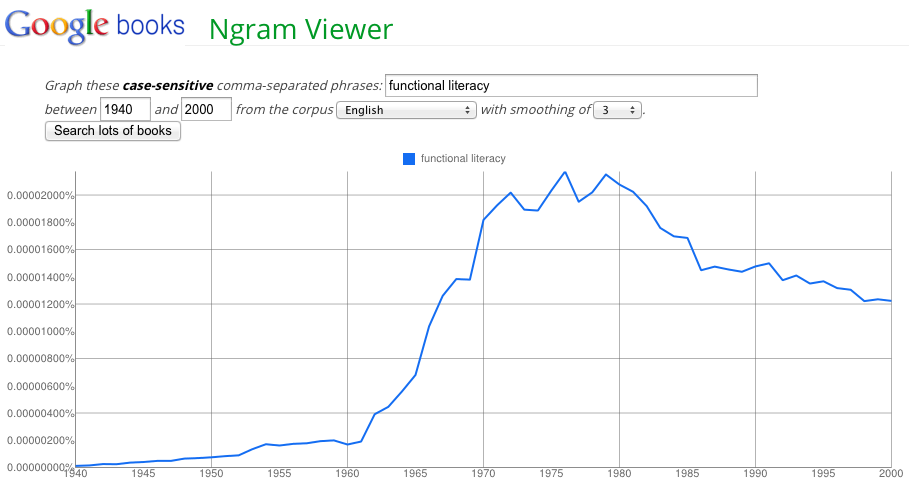
[click to enlarge]
Rise of the Literacies
The next step in the evolution of literacy came in the 1980s with the concept of computer literacy. This was the first decade of household computers. I fondly remember my (parents') Apple IIe with its green screen, big floppy drive, and complete lack of networking. Literacy came to be about competency in some area, without necessarily having a strong connection with written language. A slew of literacy terms came into common use in the 80s and especially the 90s. Information literacy really took off in the early 90s at the same time as the World Wide Web. Probably not a mere coincidence.

[click to enlarge]
Why did computer literacy usage fall while information literacy usage rose? I suspect the novelty of computers as devices was wearing off even as an understanding of networked computers as gateways to information was dawning. At present, iPads represent a high level of technological ease-of-use, but it's still up to human users to wisely locate, evaluate, and use information.
Definitions
There is an ongoing controversy among librarians and other professionals about the precise meaning of information literacy. I take this as evidence that the term "information literacy" is being used to label a bundle of concepts, and not everyone's bundle is quite the same. When it comes to successful communication, the sufficiency of the term will depend on context and the assumptions of those involved. Can you tell I take a very pragmatic view of language? Anyway, let's look at the most prominent short(ish) definition of information literacy:
"To be information literate, a person must be able to recognize when information is needed and have the ability to locate, evaluate, and use effectively the needed information. [...] Ultimately, information literate people are those who have learned how to learn. They know how to learn because they know how knowledge is organized, how to find information, and how to use information in such a way that others can learn from them. They are people prepared for lifelong learning, because they can always find the information needed for any task or decision at hand." — American Library Association's Presidential Committee on Information Literacy: Final Report, 1989The Association of College and Research Libraries (ACRL) characterizes information literacy as six abilities. "An information literate individual is able to:
- Determine the extent of information needed
- Access the needed information effectively and efficiently
- Evaluate information and its sources critically
- Incorporate selected information into one’s knowledge base
- Use information effectively to accomplish a specific purpose
- Understand the economic, legal, and social issues surrounding the use of information, and access and use information ethically and legally"
from ACRL's Information Literacy Competency Standards for Higher Education, 2000ACRL fills in a lot of detail for each of these six abilities (or "standards") by breaking each one down into several "performance indicators" and each of those into "outcomes." For example:
Standard: "The information literate student evaluates information and its sources critically and incorporates selected information into his or her knowledge base and value system."Many elements in the above definitions appeared in President Obama's 2009 proclamation of National Information Literacy Awareness Month. I recommend taking a few minutes to read it over.
Indicator: "The information literate student articulates and applies initial criteria for evaluating both the information and its sources."
Outcome: "Analyzes the structure and logic of supporting arguments or methods."
Why Librarians?
You may be thinking, "Sure, information literacy is important, but it sounds so general. Why is there a special connection to libraries and librarians? Why don't librarians stick with library instruction/bibliographic instruction?" I haven't found a good, critical discussion of these questions (yet), so I'd like to break the "special connection" question into two parts and give my working hypotheses.
Why are librarians so interested in information literacy instruction?One of the less encouraging responses I've gotten to going back to school to become a librarian is, "There won't be any libraries in a decade." The assumption here is that libraries exist to access books, films, etc. and that libraries won't be needed for much longer due to Internet services like Amazon, Netflix, etc. Libraries are dinosaurs on the verge of following Borders and Hollywood Video to extinction. Maybe public funds would be better spent on direct student or citizen access to digital resources.
At least, this is one specter haunting modern libraries. I see information literacy as a way of establishing continued relevance in the twenty-first century. Access to information may become trivial, but librarians can still function as professional facilitators and teachers of information selection, evaluation, and use. Even the term "Library and Information Science" reflects this shift in philosophy.
Why are librarians relatively more active in the promotion of information literacy compared to other groups?Basically, librarians are more keyed into these issues as general issues than, say, chemistry or veterinary school teachers. Commercial enterprises and political organizations may be in excellent positions to understand information literacy, but they tend to view people as voters and consumers to manipulate, rather than as individuals to empower. When it comes to spreading the message about information literacy, librarians stand at a particularly relevant intersection of professionalism and philosophy.
Friday, May 18, 2012
The Heterosexual Redefinition of Marriage
Critics of same-sex marriage offer a narrative along these lines:
Give Me That Old Time Marriage
Appeals to "traditional marriage" usually invoke the Bible for support, but our marriage tradition has come a long way from Old Testament and even New Testament views on marriage. The Old Testament is especially relevant since religious arguments against homosexuality often rely on the assumption that ancient Jewish laws are still relevant, at least in spirit. Let's start with one of the Ten Commandments:
Violation: Consensual sex with a non-engaged virgin.
Penalty: The man must marry her and pay her father, unless the father decides to keep both the money and his daughter. The woman must comply with her father's decision. (Ex. 22:16-17)
Violation: Rape of a non-engaged virgin.
Penalty: The man must marry her and pay her father. He can never divorce her. The woman must marry her rapist. (Deut. 22:28-29)
Violation: Consensual sex or rape of an engaged virgin in the city.
Penalty: Both stoned to death. The man for "violat[ing] his neighbor's wife." The woman for not crying out for help; all city sex is presumed to be consensual. (Deut. 22:23-24, NASB)
Violation: Consensual sex or rape of an engaged virgin in the country.
Penalty: The man is stoned to death for harming her fiancé (yes really). No penalty for the woman because she is presumed to have cried out for help, but there was no one in earshot to save her. (Deut. 22:25-27)
Violation: A supposed virgin lacks a hymen on her wedding night.
Penalty: She is stoned to death at the doorway of her father's house. (Deut. 22:20-21)
Violation: A man falsely accuses his new wife of lacking a hymen.
Penalty: The man must pay a fine to her father, and he can never divorce her. (Deut. 22:13-19)
I realize this notion of forcing women to marry their rapists seems really out of touch with contemporary morality, but I want to be fair and give Hank Hanegraaff a.k.a. Bible Answer Man an opportunity to provide some cultural context:
War Booty
We think of marriage as a mutual choice to commit to each other for life. While there might be some room to hope Israelite fathers consulted their daughters on their choice of husband, foreign women taken after the slaughter of their families couldn't have had any choice but to sexually submit to the men who killed their fathers, mothers, sisters, and brothers.
Big Love
Polygamy, like slavery, was regulated rather than condemned in the Bible. Sometimes these regulations were intertwined:
The Lord Your Husband
New Testament views on marriage may seem pretty close to our own, but this might just be a matter of focus. New Testament writers don't discuss marriage arrangements and rules for slavery as much as Old Testament writers did. Polygamy seems to have gone out of style. Slavery is acknowledged but not challenged (Colossians 4:1). The ruler-and-subject concept of marriage was explicitly re-affirmed. Paul wrote:
Before the Uprising
By the 1760s, around the time of the American Revolution, marriage had evolved in some respects. William Blackstone's Commentaries on the Laws of England carefully distinguished civil marriage from holy matrimony. Both the husband and wife had to consent to the marriage, though boys under 14 and girls under 12 could be "imperfect[ly]" married, then allowed to decide to affirm or void the marriage at those respective ages. Affirmation was implied to involve voluntary sexual union after reaching his or her "years of discretion." Polygamy was expressly forbidden. Forcing slaves into marriage was not addressed, but was likely precluded by the same principle behind the general consent requirement. All of this represents a substantial advance toward modern views on marriage.
Still, once a woman chose to enter into a marriage, she gave up a lot more than her maiden name. Blackstone wrote:
The Age of Equality
The Married Women's Property Acts of 1870 and 1882 allowed women in the United Kingdom to own property separately from their husbands. The latter version also recognized women as separate legal entities in many of the ways denied to them under the doctrine of coverage, as discussed by Blackstone above.
One year before the first Married Women's Property Act was passed, John Stuart Mill's essay The Subjection of Women had raised public awareness of the legal inequalities experienced by married women. In practice, husbands had dominion even over their wives' bodies.
An Open Door
What does all of this have to do with same-sex marriage? I wanted to show that homosexual marriage is — as its opponents claim — incompatible with traditional marriage. But then so are all the heterosexual marriages today which don't feature a man-as-master and a woman-as-servant. A defining characteristic of traditional marriage was a difference in authority based on sex, not merely a difference in sex. This explains why same-sex marriage is an almost entirely new phenomenon, previously blocked by the expectation of inequality. As a contemporary historian puts it:
Marriage has always meant "a union between a man and a woman" therefore it makes no sense to talk about two men or two women marrying each other. Homosexuals are trying to redefine the word "marriage" to mean something completely different from what marriage is!While it's true that, historically, marriages have nearly always been heterosexual relationships, there is another very plausible explanation: marriage was a kind of male-oriented ownership relation. A man could possess one or more wives, but it it made no sense for men to possess each other or for women to possess each other in this way. It was only with the modern women's movement that marriage has commonly come to mean a co-equal life partnership. Our culture's acceptance of this heterosexual redefinition of marriage from ownership to partnership has already opened the concept of marriage to homosexual partners. Gays and lesbians don't need to redefine marriage. Straights have already done so.
Give Me That Old Time Marriage
Appeals to "traditional marriage" usually invoke the Bible for support, but our marriage tradition has come a long way from Old Testament and even New Testament views on marriage. The Old Testament is especially relevant since religious arguments against homosexuality often rely on the assumption that ancient Jewish laws are still relevant, at least in spirit. Let's start with one of the Ten Commandments:
"You shall not covet your neighbor’s house; you shall not covet your neighbor’s wife or his male servant or his female servant or his ox or his donkey or anything that belongs to your neighbor." Exodus 20:17, NASBThis sure looks like a rule for men about respecting other men's things. At least the neighbor's wife was mentioned before the donkey, even if she does come after the house. Unmarried women were the property of their fathers or their fiancés. If another man were to come along and break her seal (so to speak), it was a crime against the man she belonged to.
Violation: Consensual sex with a non-engaged virgin.
Penalty: The man must marry her and pay her father, unless the father decides to keep both the money and his daughter. The woman must comply with her father's decision. (Ex. 22:16-17)
Violation: Rape of a non-engaged virgin.
Penalty: The man must marry her and pay her father. He can never divorce her. The woman must marry her rapist. (Deut. 22:28-29)
Violation: Consensual sex or rape of an engaged virgin in the city.
Penalty: Both stoned to death. The man for "violat[ing] his neighbor's wife." The woman for not crying out for help; all city sex is presumed to be consensual. (Deut. 22:23-24, NASB)
Violation: Consensual sex or rape of an engaged virgin in the country.
Penalty: The man is stoned to death for harming her fiancé (yes really). No penalty for the woman because she is presumed to have cried out for help, but there was no one in earshot to save her. (Deut. 22:25-27)
Violation: A supposed virgin lacks a hymen on her wedding night.
Penalty: She is stoned to death at the doorway of her father's house. (Deut. 22:20-21)
Violation: A man falsely accuses his new wife of lacking a hymen.
Penalty: The man must pay a fine to her father, and he can never divorce her. (Deut. 22:13-19)
I realize this notion of forcing women to marry their rapists seems really out of touch with contemporary morality, but I want to be fair and give Hank Hanegraaff a.k.a. Bible Answer Man an opportunity to provide some cultural context:
"First, the Mosaic Law is hardly about letting a rapist off easy. The consequence for raping a woman engaged to be married was stoning (Deuteronomy 22:25). If the woman was not engaged, the rapist was spared for the sake of the woman’s security. Having lost her virginity, she would have been deemed undesirable for marriage—and in the culture of the day, a woman without a father or husband to provide for her would be subject to a life of abject poverty, destitution, and social ostracism. As such, the rapist was compelled to provide for the rape victim for as long as he lived. Thus, far from barbaric, the law was a cultural means of protection and provision." — Hanegraaf in answer to "How could the Bible command a rape victim to marry her rapist?"A strange answer considering a nation's laws would be an opportune place to provide for the welfare of poor women by other means. At any rate, rape was treated primarily as a harm done to a woman's father or fiancé, which can only be justified under a property view of women.
War Booty
We think of marriage as a mutual choice to commit to each other for life. While there might be some room to hope Israelite fathers consulted their daughters on their choice of husband, foreign women taken after the slaughter of their families couldn't have had any choice but to sexually submit to the men who killed their fathers, mothers, sisters, and brothers.
"When you go out to battle against your enemies, and the Lord your God delivers them into your hands and you take them away captive, and see among the captives a beautiful woman, and have a desire for her and would take her as a wife for yourself, then you shall bring her home to your house, and she shall shave her head and trim her nails. She shall also remove the clothes of her captivity and shall remain in your house, and mourn her father and mother a full month; and after that you may go in to her and be her husband and she shall be your wife. It shall be, if you are not pleased with her, then you shall let her go wherever she wishes; but you shall certainly not sell her for money, you shall not mistreat her, because you have humbled her." — Deut. 21:10-14, NASB
"Now therefore, kill every male among the little ones, and kill every woman who has known man intimately. But all the girls who have not known man intimately, spare for yourselves. [...]Forcing an enslaved woman into the marriage bed isn't even permanent. When you tire of her, send her away. Just don't "mistreat" her! Can you imagine the reaction if modern Israel tried this policy of genocide-except-the-virgins? Would we recognize such marriages as marriages?
Now the booty that remained from the spoil which the men of war had plundered was 675,000 sheep, and 72,000 cattle, and 61,000 donkeys, and of human beings, of the women who had not known man intimately, all the persons were 32,000." — Num. 31:17-18, NASB
Big Love
Polygamy, like slavery, was regulated rather than condemned in the Bible. Sometimes these regulations were intertwined:
"If a man sells his daughter as a female slave, she is not to go free as the male slaves do. If she is displeasing in the eyes of her master who designated her for himself, then he shall let her be redeemed. He does not have authority to sell her to a foreign people because of his unfairness to her. If he designates her for his son, he shall deal with her according to the custom of daughters. If he takes to himself another woman, he may not reduce her food, her clothing, or her conjugal rights." Ex. 21:7-10, NASBOr there's the law about polygamy and inheritance:
"If a man has two wives, the one loved and the other unloved, and both the loved and the unloved have borne him sons, if the firstborn son belongs to the unloved, then it shall be in the day he wills what he has to his sons, he cannot make the son of the loved the firstborn before the son of the unloved, who is the firstborn." Deut. 21:15-16, NASBNot to mention that prominent holy men like Abraham, Jacob, Gideon, David, and Solomon were never condemned for practicing polygamy as such.
The Lord Your Husband
New Testament views on marriage may seem pretty close to our own, but this might just be a matter of focus. New Testament writers don't discuss marriage arrangements and rules for slavery as much as Old Testament writers did. Polygamy seems to have gone out of style. Slavery is acknowledged but not challenged (Colossians 4:1). The ruler-and-subject concept of marriage was explicitly re-affirmed. Paul wrote:
"Wives, be subject to your own husbands, as to the Lord. For the husband is the head of the wife, as Christ also is the head of the church, He Himself being the Savior of the body. But as the church is subject to Christ, so also the wives ought to be to their husbands in everything. [...]Women are told to be submissive; men are told to be loving. There is an order here with God above both men and women equally, yet husbands are still clearly above their wives. Paul reinforced this double hierarchy in 1 Corinthians:
So husbands ought also to love their own wives as their own bodies. He who loves his own wife loves himself; for no one ever hated his own flesh, but nourishes and cherishes it, just as Christ also does the church, because we are members of His body." Eph. 5:22-24, NASB
"For if a woman does not cover her head, let her also have her hair cut off; but if it is disgraceful for a woman to have her hair cut off or her head shaved, let her cover her head. For a man ought not to have his head covered, since he is the image and glory of God; but the woman is the glory of man. For man does not originate from woman, but woman from man; for indeed man was not created for the woman’s sake, but woman for the man’s sake. Therefore the woman ought to have a symbol of authority on her head, because of the angels.To review, marriage in the Old Testament treated women as property purchased from their fathers, or as spoils of war plundered from enemies. Polygamy was occasionally practiced, but polyandry was unheard of. The New Testament urged women to be unilaterally submissive to their husbands. Husbands were to love their wives, not as separate persons, but as part of themselves. The concepts of mutual choice and co-equal partnership in marriage did not yet exist.
However, in the Lord, neither is woman independent of man, nor is man independent of woman. For as the woman originates from the man, so also the man has his birth through the woman; and all things originate from God." 1 Cor. 11:6-12, NASB
Before the Uprising
By the 1760s, around the time of the American Revolution, marriage had evolved in some respects. William Blackstone's Commentaries on the Laws of England carefully distinguished civil marriage from holy matrimony. Both the husband and wife had to consent to the marriage, though boys under 14 and girls under 12 could be "imperfect[ly]" married, then allowed to decide to affirm or void the marriage at those respective ages. Affirmation was implied to involve voluntary sexual union after reaching his or her "years of discretion." Polygamy was expressly forbidden. Forcing slaves into marriage was not addressed, but was likely precluded by the same principle behind the general consent requirement. All of this represents a substantial advance toward modern views on marriage.
Still, once a woman chose to enter into a marriage, she gave up a lot more than her maiden name. Blackstone wrote:
"By marriage, the husband and wife are one person in law: that is, the very being or legal existence of the woman is suspended during the marriage, or at least is incorporated and consolidated into that of the husband: under whose wing, protection, and cover, she performs everything; and is therefore called in our law-french a feme-covert [married woman]; is said to be covert-baron, or under the protection and influence of her husband, her baron, or lord; and her condition during her marriage is called her coverture. [...]If any form of marriage deserves to be called "traditional," it's marriage as the lordship of a man over a woman.
For this reason, a man cannot grant anything to his wife, or enter into covenant with her: for the grant would be to suppose her separate existence; and to covenant with her, would be only to covenant with himself: and therefore it is also generally true, that all compacts made between husband and wife, when single, are voided by the intermarriage. [...]
If the wife be injured in her person or her property, she can bring no action for redress without her husband's concurrence, and in his name, as well as her own: neither can she be sued, without making the husband a defendant. [...]
But, in trials of any sort, they are not allowed to be evidence for, or against, each other: partly because it is impossible their testimony should be indifferent; but principally because of the union of person: and therefore, if they were admitted to be witnesses for each other, they would contradict one maxim of law, "nemo in propria causa testis esse debet" [no one ought to be witness in his own cause]; and if against each other, they would contradict another maxim, "nemo tenetur seipsum accusare" [no one is bound to accuse himself]." — Commentaries on the Laws of England, Book 1, Chapter 15
The Age of Equality
The Married Women's Property Acts of 1870 and 1882 allowed women in the United Kingdom to own property separately from their husbands. The latter version also recognized women as separate legal entities in many of the ways denied to them under the doctrine of coverage, as discussed by Blackstone above.
One year before the first Married Women's Property Act was passed, John Stuart Mill's essay The Subjection of Women had raised public awareness of the legal inequalities experienced by married women. In practice, husbands had dominion even over their wives' bodies.
"[A] female slave has (in Christian countries) an admitted right, and is considered under a moral obligation, to refuse to her master the last familiarity. Not so the wife: however brutal a tyrant she may unfortunately be chained to — though she may know that he hates her, though it may be his daily pleasure to torture her, and though she may feel it impossible not to loathe him — he can claim from her and enforce the lowest degradation of a human being, that of being made the instrument of an animal function contrary to her inclinations." — John Stuart Mill, The Subjection of Women, Chapter TwoIn case the language was unclear, husbands could demand sex whether their wives were willing or not. Husbands could also imprison their wives. At least, they could get away with doing this in England until the watershed "Clitheroe case" (Regina v. Jackson) of 1891. Frustrated with his wife's refusal to live with him, Mr. Jackson and two of his friends seized her as she was coming out of church with her sister, and dragged Mrs. Jackson into a carriage. She was kept in his house, guarded by his friends, while her family "laid siege" to the house and filed for habeas corpus. The first judges refused to intervene, but an appeal judge ruled that a husband may not "imprison" his wife "until she consent[s] to the restitution of conjugal rights." An early women's rights activist wrote in a letter to the editor:
"Of the momentous character of this judgment there can be no question whatever. It is a declaration of law which is epoch-making in its immediate consequences, and its ultimate results reach far into the future, involving indeed the establishment of a higher morality of marriage, and the substitution, in the relation of husband and wife, of the ethics of justice and equality for the old and worn-out code of master and slave." — Elizabeth Wolstenholme Elmy, The Decision in the Clitheroe Case, and Its ConsequencesThis is precisely the modern "redefinition" of the marriage relationship that this post is about. The idea of partnership marriage has taken time to spread, and is still struggling against the idea of male authoritarian marriage. Stephen Grunlan's recent Christian textbook, Marriage and the Family, has a section explicitly devoted to comparing arguments for "traditional marriage" and "partnership marriage," ultimately leaving it up to the convictions of each couple. It's not a simple matter of religious marriage being one way and secular marriage being the other.
An Open Door
What does all of this have to do with same-sex marriage? I wanted to show that homosexual marriage is — as its opponents claim — incompatible with traditional marriage. But then so are all the heterosexual marriages today which don't feature a man-as-master and a woman-as-servant. A defining characteristic of traditional marriage was a difference in authority based on sex, not merely a difference in sex. This explains why same-sex marriage is an almost entirely new phenomenon, previously blocked by the expectation of inequality. As a contemporary historian puts it:
"The ancient Romans had no problem with homosexuality, and they did not think that heterosexual marriage was sacred. The reason they found male-male marriage repugnant was that no real man would ever agree to play the subordinate role demanded of a Roman wife. Today, by contrast, many heterosexual couples aspire to achieve the loyal, egalitarian relationships that Greek and Roman philosophers believed could exist only in a friendship between two men." — Stephanie Coontz, Marriage, a History: How Love Conquered Marriage, Kindle Edition p. 11.The long fight against sexism in marriage has opened the door for same-sex marriage. The most respectable form of marriage today is that of a co-equal life partnership, and there's no reason two men, two women, or one of each cannot make this same kind of commitment to each other.
Subscribe to:
Posts (Atom)