Thursday, August 15, 2013

The Terrible and Terribly Important Notion of Fiction Genres

Genres are a marketing ploy. Genres are a barrier to discovery. Genres are a curse we can't do without.

Let me back up a minute and give you some context. I'm interning at the county jail library this summer and fall. Well, "library" would be more accurate because it's a room of over ten-thousand books thrown together without organization. Staff members have kept some very popular authors and series set aside, but any inmate requests outside of those are unlikely to be filled. There's no way to locate or even confirm the existence of those items. My job is to do a lot of the grunt work in turning this pile into a collection.

Inmates can request a particular title, author, or genre. They won't be able to browse the shelves directly. I knew that if I had a big "General Fiction" category, not many people are going to write: "Please find me some General Fiction novels!" How utterly boring! Might as well throw out every less popular author in that entire section.

I needed to come up with enough genres to put an interesting genre label on everything, even titles not traditionally considered "genre fiction." After much agonizing, I came up with the following scheme:


A cheating category. Classics are, roughly, pre-20th century books that are still reprinted or re-translated. Sherlock Holmes and Dracula would fit, but they are so strongly expected in other genres that they don't count.

Traditional "Genre Fiction"


Sure, these can be separate, but readership and the works themselves very frequently cross over. Plus, that's a rockin' dragon sticker. What goes here? Advanced technology, strange worlds, and supernatural things that most people agree aren't real.


Anything explicitly labeled "romance" or from a romance imprint goes here, even if it has strong SF/Fantasy elements. Also included are books with descriptions that exclusively describe a romantic relationship, i.e. not just as a major element in a story focused on another kind of struggle. It's no accident that I picked a non-gendered sticker.


Like romance, westerns are predominately identified by their marketing. Although there are many titles that mix romance and western themes, it's usually easy to tell romantic westerns from western romances. Unfortunately, this distinction tends to line up with marketing to men vs. marketing to women. This is one way that genre labels stifle discovery by exaggerating the separation between quite similar works.


Some mysteries are labeled as such, but it makes sense to be more inclusive than that. Whenever the plot centers on discovering the identity of a criminal, it's a mystery. SF/Fantasy mysteries still get dragon stickers.

General Fiction and Literature

With "genre fiction" out of the way, what can be done about the great big Miscellaneous category found in most bookstores and libraries? I broke it down into three parts...


An arbitrary but popular line to draw is that fiction set during or before the World Wars counts as historical fiction. Unless it fits western conventions, or those for SF/Fantasy, or mysteries. Even with all of these exclusions, these shelves are bursting.


Thrillers is the section for spies, soldiers, and serial killers. Film versions of thriller books go under Action/Adventure. Crime fiction can go here if the reader finds out the antagonist's identity early on and the big question is whether the protagonist can do something about it.


Technically, thrillers tend to be realistic in the sense that they are contemporary stories without fantasy or science fiction elements. Realistic fiction concerns relatively regular people in relatively common life situations, though not necessarily from the reader's own culture. Film versions of these books tend to go under Drama. Elements of romance, thriller, and mystery genres can be present, so long as they don't overwhelm the focus on complex contemporary characters.


What About...


It might be OK for Barnes & Noble to have a Christian Fiction section, but it doesn't sit so well with librarians because it can imply that the other fiction either is less suitable for Christians to read or is insufficiently orthodox. State librarians are not in the position to issue or promote religious imprimaturs. Plus, it pulls books away from from all of the other genre shelves where they might find a broader readership. The Chronicles of Narnia, Left Behind, and Seasons of Grace are much more at home in SF/Fantasy, Thrillers, and Realistic Fiction respectively.

That said, some readers are publishers and readers who favor books with strong religious themes. Other readers feel strongly about avoiding books from such publishers, either from religious disagreement or for the same reason a person who likes romantic fiction might distrust the quality standards of "romance mill" publishers. So, in addition to a primary genre sticker, books from such publishers or imprints (e.g. Harlequin's Heartsong) will have an "Inspirational" label:


Not the most apt term, but it's a widely-understood convention that further distances librarians from the legal and ethical issues of judging some works to be "Christian Fiction."


Easy and Limiting

The single best article I've read on fiction genres is Ursula K. LeGuin's "Genre: A Word Only a Frenchman Could Love" (Public Libraries, Vol. 44, Is. 1, p. 21 [PDF]). I recommend reading the whole thing. LeGuin would prefer a world where all fiction is interfiled by author's last name, removing the prejudice of genre systems. But she knows her vision would be opposed:
"Consumerism also rules. If the books aren’t labeled, if they aren’t shelved by genre, if they don’t have a little bitty label saying SF or M or YA, a whole lot of customers and library users will come storming the counter or the desk, shouting, 'Where is my fiction fix? I want a fantasy, I can’t read all that realistic stuff! I want a mystery, I can’t read all that plotless stuff! I want a masterpiece of grim realism, I can’t read all that imaginary stuff! I want mindless fluff, I can’t read all that literary stuff! Etc., etc.'

To give each reader an annotated author-title list of whatever their fiction addiction is, so they can go find the books on the shelves, is a perfectly fair solution, offered by many libraries. But addicts don’t like it. They want books to be easy the way fast food is easy. They want to go to the shelf and stick out their hand and get a fix."
For my particular situation of no-browsing-allowed, sticking out a hand (so to speak) is the best supported scenario for discovering new books. Can public and school libraries do better? I'm having trouble finding references right now, but I've heard of libraries interfiling all fiction and using small, colored genre dots on the spines. The nice thing is that there's no need to pick a "primary" genre, so those readers of western romances and romantic westerns are more likely to notice similarly-themed works and go exploring outside of their traditional haunts. Heck, I've seen things like inspirational-historical fiction-romance and SF-mystery-thriller. These books could easily be picking up new readers through providing more genre information than traditional genre shelving supports.

Library catalogs could also help, but usable catalogs are still the stuff of science fiction. For now, physical genre markers are still the best way of directing many people to titles they'll feel comfortable trying out.

Thursday, May 16, 2013

Recipe: Maple Twist

My father's side of the family is Mennonite in the strongly traditional way many families in Boston are Catholic. When I see women in old fashioned dresses and bonnets, I think: cousins! But as readers of this blog will know, I've not stuck with the tradition myself. Still, there are three ways Mennonite heritage has left its mark on me: a cool-headed temperament, a simple "yes" or "no" for my word, and warm maple twist.

This is my go-to dessert when I need to bake something impressive in a few hours. Plus, the shaping part is fun!


1. Make (Most Of) The Dough
2 and 3/4 cup general-purpose flour (385g)
3 tablespoon sugar (40g)
1/2 teaspoon salt (3g)
2 and 1/4 teaspoon yeast (8g)
1 teaspoon maple extract (6g) [imitation is fine]
1 egg
Mix this stuff and set aside.


2. Warm Up Milk and Butter
3/4 cup milk (156g)
1/4 c unsalted butter, melted (62g)
Use a microwave, or put the butter on the stove at the lowest setting and apply patience or foresight. Mix with the milk and make sure the resulting liquid is warm on your skin but not uncomfortably hot, otherwise your yeast will be sad.


3. Combine

Add the milk and butter to the mix set aside in step one. Knead until smooth.

Not smooth


Smooth


Put the ball of dough into a greased container and cover it. Let rise for an hour at room temperature.


4. Make Filling

This can be done any time during or just after the dough rising hour. Mix together:
1/2 cup sugar (105g)
1 teaspoon maple extract (6g)
1 teaspoon cinnamon (2g)
1/3 cup chopped almonds (28g) [or whatever you like]

5. Turn One Into Three

When the hour is up, start melting another 1/4 cup of unsalted butter (62g). You'll need it shortly.

Now, take the dough ball out of its container and split it into three equal parts. Flatten out each part into a circle about 9 inches or 23 cm in diameter.


6. Stack'm

Put one of the dough circles onto a greased pan, brush it with the freshly melted butter, then sprinkle about a third of the filling on top.


Put the second circle of dough on top, butter, and sprinkle. Same for the third.


If the whole thing has contracted a bit, just flatten it back to full size.


7. Slice'm


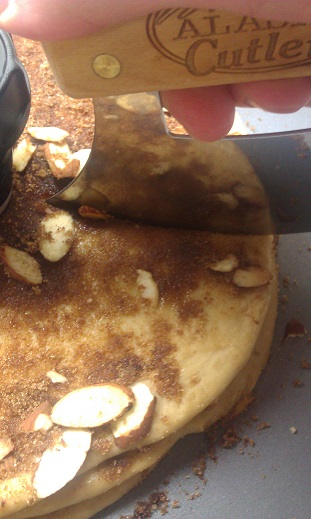
Find a traditional, Mennonite shot glass...or anything around that size (I use the lid of my Thermos). Press your doohickey down in the middle of the dough to act as a guide and to hold the middle down.

Find a traditional, Mennonite ulu...or anything sharp enough to cut dough. Make a cut from the edge to maybe half an inch from the thing you're holding down in the middle.


Then do the same on the opposite side. And between each of these cuts, making four evenly-spaced cuts total.


Then cut between each of the original four cuts, making eight cuts total. Finally, cut between each of the eight cuts—but not quite so far—making sixteen cuts.


8. Twist'm

Pull each of the sixteen wedges out slightly then twist!


I like do about six or seven half turns with my right thumb and forefinger while I use my left hand to hold the last twisted wedge in place and apply light pressure to the doohickey in the center (left hand not shown here because it's holding the camera).


A convenient way to keep the twists from contracting back toward the center is to bend each one around the last, forming a big spiral.


9. Bake

Cover and let rise for another half hour. Meanwhile, preheat the oven to 375 F (190 C).

Bake for about twenty minutes until golden brown. This is thick enough to justify using aluminum foil on top for part of the time.


10. Drizzle

While the twist is cooling on the pan or presentation plate, mix together:
1/8 cup unsalted butter, melted (31g)
1 cup powdered sugar (83g)
2 tablespoons milk (28g)
1/2 teaspoon maple extract (3g)
Apply icing liberally to produce the final result:


Sunday, April 14, 2013

Big Data and the Future of Collections Management

[A presentation I gave for Collections Management class. You can follow the clicks in this embedded Prezi to simulate the experience.]


"Big data" is a big buzzword in business and technology circles. If some had asked me a year ago to define big data, I would have talked about credit card and credit score companies. I would have talked about Google harvesting email content. I would have talked about social networking graphs.

[click]

But this sharp increase in data collection is just the first step. The soul of big data is in its use. [click] And the magic of big data is that its use is [click] not predetermined.

To see what I mean, let's take a minute to think about scientific method. [click] Remember this from grade school?
  • Form a hypothesis.
  • Design an experiment.
  • Then: Collect data.
  • Analyze data.
  • Draw a conclusion.
Big data allows a different approach. [click] Data collection happens first. And here's the key: this data is more or less complete. There's no need to design an experiment to generate some data that's relevant to a specific hypothesis; we just work from all the data! This is a data driven approach to finding patterns, including patterns we never would have hypothesized.

For example [click], when Walmart's analysts searched their sales history for interesting patterns, they found a connection between [click] looming hurricanes and the sale of [click] flashlights! Ok, that's not too surprising. They also found a strong correlation between hurricanes and [click] pop tarts! Who knew? Even individual pop tart purchasers may not have perceived they're part of a pattern; a wider perspective was required. So Walmart did the obvious thing, they waited for a hurricane and shipped truckloads of extra pop tarts to select stores. They sold like hotcakes! Or should I say, like pop tarts before a hurricane? [click]

The authors of the book on which this talk is based wrote:
"Big data refers to things one can do at a large scale that cannot be done at a smaller one." p. 6
Let's see what another retail giant has accomplished with large scale data. [click]

Target sometimes advertises by sending 'targeted' coupons to individual customers. It's like Amazon.com's personalized recommendations. Of course, the better the match between coupons and customer needs, the higher the chance that people will get in their cars, drive to Target, and buy things!

Here's the creepy part. Target's analysts wanted to know if they could identify pregnant customers. So they started with customers who had registered for baby showers and searched for patterns in their purchase histories. It turns out that customers who purchase cotton balls and unscented lotion are more likely to be pregnant, especially if this is followed up by certain vitamins and minerals or over twenty other pregnancy-correlated items. In fact, this progression of purchases can even produce a projected due date! There's even a story about a father who came in to Target upset because his teenage daughter had received coupons for baby cribs. Target knew before he did!

If big data is sounding powerful and a little scary, you've got the right idea. [click]

Now we're ready to talk about big data in the context of public library collections management. [click]

What's the difference between a library and a book store? One difference is that book stores are ultimately about making money, while libraries are ultimately about serving their patrons. As we saw with Target, big data can be used to trade away privacy for profit. It seems inevitable that retail stores will use big data in more and more invasive ways [click]. If this happens, all libraries need to do is maintain their reputation for privacy and their value will grow. It would even make sense for collection development policies to mention a preference for materials of confidential interest.[click]

On the other hand, libraries are very well situated to take advantage of big data techniques. Unlike Walmart or Kmart transactions, every checkout is tied to a loyalty card...I mean a library card. I can't tell you what patterns a team of big data analysts would reveal in library data. But when we find our equivalent to pop-tarts or unscented lotion, we might order more or fewer of certain materials, rearrange items, or set up displays at more effective times.[click] [click]

Obviously, there's some tension between maintaining privacy and using library data to its fullest. We could add a line to due date phone calls: "This is Lincoln Public Libraries. We are calling to inform you that you have an item due on Thursday... and you might also enjoy Surprise Child: Finding Hope in Unexpected Pregnancy!" Yes, that might scare people away. Thankfully, libraries don't need to rely on their own data to take a big data approach. [click]

We can use public data. Even without big data analysis, individual collection managers can (and should!) follow best seller lists, social networking trends, and top news stories. Big data analysis goes deeper. It might be possible to predict the next big things before they make their way to the top. Libraries could be ready to meet demands for the next 50 Shades, not lag weeks behind retail stores. If a historically-themed movie is coming out, it would make sense to review materials on that subject, but only if public interest really is picking up; big data might be able to tell the difference. [click]

In summary, big data is powerful and a little scary. It's not something for the average librarian to use directly, but I believe it is everyone's responsibility to steer the profession between the extremes of neglecting and overusing this technology. We need to adapt to big data, but we also need to adapt big data to our professional ethics.

Thank you. [click]

Wednesday, April 3, 2013

On "Filtering and the First Amendment"

Since Deborah Caldwell-Stone's American Libraries article "Filtering and the First Amendment" covers similar ground to my earlier essay "Public Forum Doctrine in U.S. v. American Library Association," I'd like to do some friendly nit-picking.

Quick Background

In the United States, public and school libraries are bribed (rather than coerced) into filtering Internet access for minors. This is done through CIPA, the Children's Internet Protection Act. In 2003, the constitutionality of CIPA was challenged but upheld in U.S. v. American Library Association.

Clarity

Caldwell-Stone's article is helpful because misconceptions about the requirements of CIPA are indeed widespread:
"Often, it is because the institutions and individuals responsible for implementing these policies misunderstand or misinterpret CIPA and the Supreme Court decision upholding the law. Among these misunderstandings is a belief that an institution will lose all federal funding if it does not block all potentially inappropriate sites to the fullest extent practicable, or that the Supreme Court decision authorized mandatory filtering for adults and youths alike. Another mistaken belief is that it does not violate the First Amendment to impose restrictive filtering policies that deny adults full access to constitutionally protected materials online." (Caldwell-Stone, 2013)
I appreciate the way she raises awareness that CIPA policies aren't legal requirements and that no library's filtering has been judged too lax to qualify. If a library doesn't want to filter, they don't have to filter! If a library wants to filter lightly, they can still collect CIPA funds.

Not So Clear

My nit-picking concerns the last sentence of the quote above. Caldwell-Stone is correct that US v. ALA did not authorize mandatory filtering for adults, but the Supreme Court didn't forbid it either. Legally, it's an open question. Caldwell-Stone evidently feels strongly that such filtering violates the First Amendment (a very respectable position to have!), but it's easy for readers to be misled when legal facts and legal hopes are presented in parallel phrases.

This bit is also problematic:
"Does CIPA itself, or the 2003 Supreme Court opinion, actually authorize a library to limit an adult’s access to constitutionally protected speech? A close reading of the district court’s opinion reveals that it fails to address the Supreme Court’s directive: Libraries subject to CIPA should disable filters for adult users to assure their First Amendment rights." (Caldwell-Stone, 2013)
The Supreme Court gave no such "directive." There was no majority opinion (at all), and no such directive can be found in the plurality opinion. In fact, none of the six judges concurring in judgment said so. The Court's language is along these lines:
"Assuming that such erroneous blocking presents constitutional difficulties, any such concerns are dispelled by the ease with which patrons may have the filtering software disabled." (US v. ALA, Opinion of the Court)
Note the qualifier "assuming." The Court isn't taking a position on whether or not "such erroneous blocking presents constitutional difficulties." Suppose it were a problem for libraries to block constitutionally protected speech: easy disabling would be an antidote. Suppose it weren't a problem to block such speech: now it's an unnecessary antidote. Since this specific case didn't hinge on the constitutionality of "such erroneous blocking," the judges didn't—and couldn't—rule on the issue.

Another concurring judge wrote:
"If some libraries do not have the capacity to unblock specific Web sites or to disable the filter or if it is shown that an adult user’s election to view constitutionally protected Internet material is burdened in some other substantial way, that would be the subject for an as-applied challenge, not the facial challenge made in this case." (US v. ALA, Kennedy's concurrence)
It's entirely reasonable to conclude that a library with mandatory filtering for adults might be judged as violating First Amendment rights, just as a state denying same-sex marriage licenses might be judged (very soon, one hopes) to be violating equal protection rights. Then again, either of these situations might be judged to be constitutional.

One last concurring judge:
"Perhaps local library rules or practices could further restrict the ability of patrons to obtain 'overblocked' Internet material. [...] But we are not now considering any such local practices. We here consider only a facial challenge to the Act itself." (US v. ALA, Breyer's concurrence)
Hopefully it's clear at this point that mandatory Internet filtering for adults is not clearly unconstitutional or constitutional. I applaud Caldwell-Stone for her explanations and her advocacy; I just wish she would separate the two a little more explicitly.


References

Caldwell-Stone, D. (April 2, 2013). Filtering and the first amendment. American Libraries. Retrieved from http://americanlibrariesmagazine.org/features/04022013/filtering-and-first-amendment

United States v. American Library Association, 539 U.S. 194 (2003).

Saturday, March 16, 2013

Quote of the Day: Moon on Parental Despotism

"We need to take a hard look at the rights of the young to access information. It is an issue we have avoided for far too long. And what seems to have become our traditional stance—that it is up to parents to control the reading and viewing of their offspring—may be politically expedient but it isn't particularly principled.

The arrival of compulsory education provided one escape route for those children whose parents seemed determined to establish a dynasty of ignorance. Some parents still struggle to protect their children from education but, by and large, society has come to accept education as among the rights of the young. Society usually does things for selfish reasons, however, and this may be no more than acceptance that the need for an educated next generation to continue or improve upon what we have wrought is so important that it must even supersede the rather despotic rights we have customarily accorded to parents.

The question for us, though, is do we then accept that the child's or young adult's right of access to knowledge stops when the school doors close? Do we believe that education happens only in school, that libraries are not educational, that they are less important, less relevant than schools? If we do not believe these things, then how come we do not protest as strongly when an individual parent bars the door of the library (or the adult section) to his or her child as when the governor of a state stands in the schoolhouse door and bars entry to children who seek nothing more dangerous than an equal crack at a decent education?"

— from Eric Moon's inaugural address as president for the American Library Association at the conference in Detroit in 1977, as quoted in Lillian Gerhardt's critical editorial on page 9 of the Sept. 1977 issue of School Library Journal.

Wednesday, March 6, 2013

Quote of the Day: Public Libraries as Literary Culture Incubators

"The third and last class of objections to public libraries to which I shall direct your attention relates to the kind and quality of the books circulated. These objections, which are usually made by educated and scholarly persons, are based on an entire misconception of the facts in the case. The objectors do not divest themselves of the old ideas that libraries are established for the exclusive benefit of scholars; whereas the purpose of these [i.e. public libraries] is to furnish reading for all classes in the community. On no other principle would a general tax for their support be justifiable.

The masses of a community have very little of literary and scholarly culture. They need more of this culture, and the purpose of the library is to develop and increase it. This is done by placing in their hands such books as they can read with pleasure and appreciate, and by stimulating them to acquire the habit of reading. We must first interest the reader before we can educate him; and, to this end, must commence at his own standard of intelligence.

The scholar, in his pride of intellect, forgets the progressive steps he took in his own mental development—the stories read to him in the nursery, the boy's book of adventure in which he revelled with delight, and the sentimental novel over which he shed tears in his youth. Our objector supposes that the masses will read books of his standard if they were not supplied with the books to which he objects; but he is mistaken. Shut up to this choice, they will read no books. When the habit of reading is once acquired, the reader's taste, and hence the quality of his reading, progressively improves."

Poole, WM. F. (1876). Some popular objections to public libraries. The American Library Journal 1(2), p. 48-49. [Paragraph breaks added for readability.]

Monday, February 25, 2013

Quote of the Day: Nietzsche On Complex, Historied Ideas

"With regard to the other element in punishment, its fluid element, its meaning, the idea of punishment in a very late stage of civilisation (for instance, contemporary Europe) is not content with manifesting merely one meaning, but manifests a whole synthesis "of meanings." The past general history of punishment, the history of its employment for the most diverse ends, crystallises eventually into a kind of unity, which is difficult to analyse into its parts, and which, it is necessary to emphasise, absolutely defies definition. (It is nowadays impossible to say definitely the precise reason for punishment: all ideas, in which a whole process is promiscuously comprehended, elude definition; it is only that which has no history, which can be defined.)"

— From The Genealogy of Morals, Second Essay, Section 13.

(Hat tip to John Budd for bringing this quote to my attention.)